Tuesday, April 18, 2006

Howards End

I finished Howards End last night. I very much enjoyed reading the book, although I made the mistake of reading some of the criticism that comes with my edition right away and therefore marring the original impression I had. I have a Bedford “Case Studies in Contemporary Criticism” edition, which has a lot of essays from different schools of theory. I didn’t read much, just skimmed a bit, but I read some criticisms of the book I wasn’t ready to hear. I like to just enjoy a book for a while if I can, and then think critically about it later.

Anyway, I thought it was an enjoyable read, plot-wise, and I liked the way Forster integrated his ideas and themes into the storytelling. This, however, is something Virginia Woolf didn’t like; she says Forster’s characters aren’t really characters but are simply ways of making his point. It didn’t feel that way to me – I thought the characters were interesting and believable, most of them; that the plot was engaging, although maybe clumsy in places; and that the ideas were important and ever-present, but that they didn’t threaten to turn the whole thing into a work of sociology or philosophy, as they might. I didn’t feel like I was being preached to.

I was interested in the ecological stuff going on in the book, about how people’s relationship to the land is threatened by the fast pace of life, how the automobile changes the landscape and our relationship to it, and how the city and suburbs are encroaching on the countryside. I liked the description of Margaret’s disorientation when she rides in a “motorcar” and loses her sense of space and place. She battles against a feeling of “flux”:

Margaret was silent. Marriage had not saved her from the sense of flux. London was but a foretaste of this nomadic civilization which is altering human nature so profoundly, and throws upon personal relations a stress greater than they have ever borne before. Under cosmopolitanism, if it comes, we shall receive no help from the earth. Trees and meadows and mountains will only be a spectacle, and the binding force that they once exercised on character must be entrusted to Love alone. May Love be equal to the task!

I suppose one of the flaws of the book is the way Forster gets metaphysical in a vague way, like in that last sentence – what exactly does he mean by Love? But I was struck by how modern all this sounds. Trees and meadows and mountains are all too often a spectacle for us, one we see through our car windows as we speed along on highways.

Has anyone read his novel Maurice? I’m kind of curious about that one.

Monday, April 17, 2006

Helen and Margaret go backpacking!

Or something. I'm dying to know what. I was intrigued by this passage from Howards End, spoken by Margaret to Henry Wilcox:

"Some ladies do without hotels. Are you aware that Helen and I have walked alone over the Apennines, with our luggage on our backs?"

But, alas, she gives no more details. Henry cuts her off with an assertion that she will never do such a thing again. I really want to know, though, what their trip was like. How far did they walk? How did they carry their luggage? Where and how did they sleep?

And, of course, Leonard Bast does his famous night walk. The walk that shows he has some kind of deep, romantic sensibility, in spite of his lower class origins. I've never walked the entire night, but I have gone hiking by moonlight once. It was beautiful, but frightening. Much better to walk without my flashlight on, and just let my eyes adjust to the dark; otherwise I was shutting myself off from the night rather than experiencing it.

I like what Leonard has to say about his experience:

"I'm glad I did it, and yet at the time it bored me more than I can say. And besides -- you can believe me or not as you choose -- I was very hungry. That dinner at Wimbledon -- I meant it to last me all night like other dinners. I never thought that walking would make such a difference. Why, when you're walking you want, as it were, a breakfast and luncheon and tea during the night as well, and I had nothing but a packet of Woodbines. Lord, did I feel it bad! Looking back, it wasn't what you may call enjoyment. It was more a case of sticking to it. I did stick I -- I was determined. Oh, hang it all! What's the good -- I mean, the good of living in a room for ever? There one goes on day after day, same old game, same up and down to town, until you forget there is any other game. You ought to see once in a while what's going on outside, if it's only nothing particular after all."

Exactly. He gets it exactly -- the boredom, the hunger, the determination, the needing to get out even if nothing happens, and being glad you did it in spite of everything.

Recent Acquisitions

Two new books arrived in the mail recently, both about eighteenth-century literature. One of them is Privacy, by Patricia Meyers Spacks, where she tracks 18th C. concerns about privacy and the relationship of privacy and the public sphere in fiction and other prose writings. This interests me, well, because I find the 18th C. fascinating, especially the novel, but specifically because it promises to tell me about changing ideas of the self and of interior life, and, being an introverted person, I'd like to know more about the history of the private world and how reading and writing feed into it. One of the major lessons of the 18th C, it seems to me, is that those things we often take for granted, an interior self, privacy, have a history. This is a very obvious point, but it's still fun to be reminded of it in new ways.

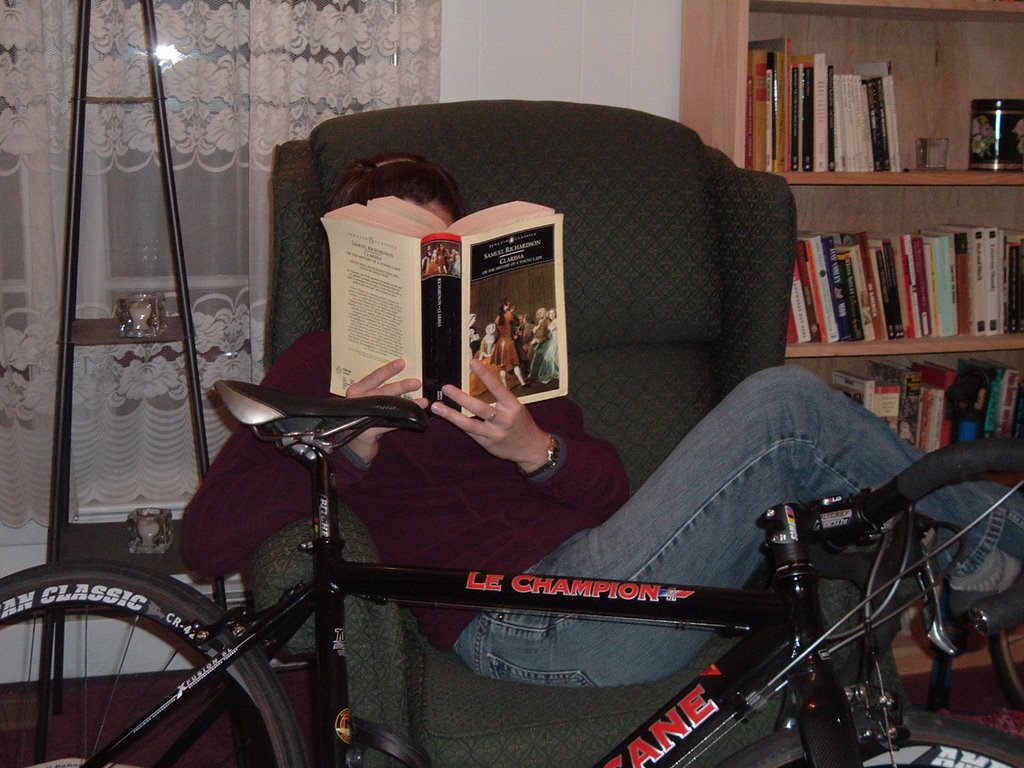
A story about Spacks: she came to a grad class I was taking quite a few years back as a guest lecturer, and the assignment was Clarissa. I'd done my best to get through the book, and had managed about 500 pages (one third). We were in class, and Spacks told us to open to a particular passage, and, in a moment of silence, a friend of mine opened her book and the spine loudly cracked. We all looked around nervously, hoping Spacks (and my professor) hadn't heard that sound that made it very clear my friend hadn't even begun the reading. But, honestly, who can read Clarissa in the middle of a busy semester? I was only able to finish the book over the following winter break.

I also ordered William Warner's book Licensing Entertainment, a book on the history of the novel and its relationship with other popular prose genres of the late 17th and early 18th centuries. This is a book I should have read in grad school, although I didn't.

I think I did, however, write about it in my comprehensive exams. I wonder if what I wrote made any sense whatsoever?

I do, generally, do my homework; it just takes me a few years sometimes.

Sunday, April 16, 2006

So, about my backpacking trip

It turned out to be a bit of a dud, unfortunately. I usually come back tired and glad to be home, enjoying a shower, a comfortable bed, and hot food, but then after a day or two I’m ready to go out again. But this time I wore myself out too much. I tried to walk too many miles each day, and it changed from a fun challenge into a wearying slog. Husband and I parked cars at each end of our route, so we kind of had to do a certain number of miles, just to reach our transportation, although we found a way to cut it a bit short along regular roads. We had thought, since the section of the Appalachian Trail we wanted to hike runs near a few towns, that we could take very little food and stop in town to pick up sandwiches instead. Our packs were, therefore, very light, and we thought that would mean we could do a lot of miles, but that wasn’t quite true. By the third day of walking, I’d had enough.

Also, part of the fun of backpacking, believe it or not, is meeting other hikers, and this time there weren’t any other hikers out, on weekdays in April. Backpacking on the Appalachian Trail, at least in the summer, can be surprisingly social. On our summer trips, we’ll run into a lot of hikers doing the whole trail – Georgia to Maine – and it’s often been fun talking with them. Yeah, sometimes you camp with strange, scary people or loud snorers, but I have a lot of good memories of hikers I’ve met and the strange, scary ones turn into good stories afterwards.

Living outdoors is great in itself, but usually we find ourselves in some kind of adventure, large or small, that makes the whole trip into something surprising. This time around, nothing particularly special happened, and I got a little bored at times. I can “experience nature” pretty well on day hikes; it’s the adventure aspect that makes backpacking so great. The one interesting animal encounter I had was getting really close, scary close, to a vulture, who seemed to be guarding a nest. I was trying to make my way up a rocky hillside, and I saw the bird about 15 feet away, and I had to get even closer to follow the trail. When I did, it flew away, but I was ready to defend myself with my hiking poles. There’s no knowing what a bird guarding its nest will do.

The landscape we went through was beautiful, and I like hiking before the leaves come out because you can see so much further into the woods. You have to be careful about sunburn, though – there is no leaf cover to protect you.

If you are interested in long-distance hiking or the AT generally, I recommend Trailjournals.com. I learned about this last summer – some hikers take along this small device, made especially for hikers I think, that they can type journal entries into, and then they send those entries to a friend over the phone when they get to the next town, and that friend posts them on the website. So you can follow the progress of hikers, getting updates once a week or so, whenever they find a phone to send in their journal. It’s kind of fun to follow their adventures, particularly when you’ve met them in person on the trail.

You may already know Bill Bryson's famous book A Walk in the Woods, definitely a good read, but you may not know Ian Marshall's Story Line, a really great book about literature written in the areas the Appalachian Trail runs through, with a description of Marshall's own hiking.

The trail is its own community, with its own vocabulary and customs. Here are a few examples of AT vocabulary:

PUDS: pointless ups and downs. I thought a lot about this word on my trip. The trail climbs to a lot of views, but it also climbs a lot for no apparent reason. You climb and you climb and you climb, and you reach nothing in particular, and then you descend and you descend and you descend. I’ve met people who get annoyed at this term and those who complain about PUDS – if you don’t want to climb hills don’t hike the AT!!! – but when I’m climbing one of these at the end of a long day, I complain too.

Thru-hikers, section-hikers, day-hikers: thru-hikers are hiking the whole trail in one trip; section-hikers (I am one of these) backpack the trail in short sections, often trying to do the whole thing eventually; and day-hikers are, obviously, out only for a day.

North-bounders, south-bounders, flip-floppers: north-bounders are hiking from Georgia to Maine; south-bounders the opposite; and flip-floppers hike from a point in the middle (say, Harpers Ferry) and hike in one direction, and then go back to the middle point and hike in the other direction.

Trail magic: some unexpectedly wonderful thing that happens to you, which can happen surprisingly often on the trail, maybe because it doesn’t take much to please a backpacker. For example, I’ve come across coolers with sodas someone left along the trail for hikers, which is a marvelous surprise. Or someone might unexpectedly offer you a shower, or a trip into town, or a hot meal. Trail magic is performed by –

Trail angels: people who help out hikers, just because they love hiking and are generous.

Trail names: people usually choose a trail name they’ll use on their backpacking trip instead of their usual name, often something related to nature, but sometimes something completely random. I’ve hiked with Out of Chocolate, Timothy Mouse, Dad’s Grin, Earthworm, Mountain Roamer, Tugboat, and Dog Tag, to name a few.

Slackpacking: when someone carries your pack for you, usually toting it to your end destination in a car, so that you can hike without the 30 pounds on your back. I wish I could do this more often!

Yellow-blazing, blue-blazing: yellow-blazing is taking a short cut along the road, which, if you have a good map or know the area, isn’t all that hard to do. It’s tempting if you want to skip a rough patch of trail or a difficult mountain on a rainy day or something similar. Blue-blazing is taking a side-trail as a shortcut. The AT is always marked with white blazes, and side-trails are blue-blazed, and sometimes those blue-blazes are faster and easier and therefore tempting.

I’d like to hike the whole Appalachian Trail before I die, although at the rate I’m going, it might be close. One problem is that I tend to hike the same sections over and over because they are nearby, and getting to the more remote sections is complicated and time-consuming. I’ll do it though ….

Saturday, April 15, 2006

An End to Suffering by Pankaj Mishra

I'll write about my backpacking trip tomorrow (too tired at the moment), but for now, here's a review of An End to Suffering I wrote before I left:

Pankaj Mishra’s book An End to Suffering has a lot of good things going for it, but ultimately I found it frustrating. I’m not saying it’s not worth reading, exactly; I don’t regret having read it, but I thought it has unfulfilled potential.

The basic idea of the book is to explore Buddhism from a number of angles: the history and teachings of the Buddha, the history of Buddhism in Asia, the European “discovery” of Buddhism in the 19th century, the response of western philosophers such as Nietzsche, the role of Buddhism in the contemporary world, and Mishra’s own discovery of and thoughts about the Buddha. The book moves back and forth among these approaches, and it moves around in time, considering early on the 19th-century response to the Buddha and only later giving an account of the Buddha’s life.

Mishra mixes the personal with the social, historical, and political. He gives a lot of details of his life in India and his later travels to England and America, and he discusses his changing ideas about the west and about his religious experiences. I find books that connect the personal to social and political issues can be deeply engaging: not just giving the dry facts about Buddhism (although those are good), but discussing what those facts mean to the author. I like to observe congenial minds making sense of information and ideas, and thinking through their implications, for the world and for the author.

But I’ve seen this sort of thing done better than it is here. One of my favorite books along these lines is Diana Eck’s Encountering God, where she considers similarities between Christianity and Hinduism, and writes about her own religious struggles along the way. I learned a lot about both religions, I found myself moved by Eck’s personal experience, and it helped me think through my own religious history. I’m always on the lookout for more books of this sort – in fact, if you know of any, please let me know!

Mishra does discuss his personal experience of Buddhism, but I got the sense that he hadn’t quite sorted out his feelings and ideas fully. This appears to be a story of his early dislike of India and fascination with the west – its explorers and philosophers – which changes over time into an appreciation of Buddhism as a viable response to the troubles of the western world. But this change is never really fleshed out, and, if this is the story he is trying to tell, it’s unconvincing. I’m not sure he’s resolved this tension between his relationship to east and west. What comes through most strongly is his admiration for all things western. Now, complicated feelings are potentially very interesting, but I want to see that the author has fully come to terms with them. Perhaps Mishra wrote the book too early in his life, before he has had time to make sense of his past.

Maybe it is a problem with the way he structures the narrative. His jumps in time end up confusing the arc of the story, so that what could be a clear narrative – about moving from a dislike of India and a fascination with the west to a more balanced view of both – becomes all jumbled up in the reader’s mind. For example, one of the first things he discusses is the “discovery” of Buddhism by 19th century European explorers, a very promising topic. But I don’t know why he writes about this first, and he never explains. In his telling of the story, he praises these explorers for their bravery, and he recognizes that they did harm too, participating in European colonialism, but the impression I get is that he is still fascinated by them almost in spite of himself and that he’s not really fully acknowledging their very mixed legacy.

At times his narrative jumps become hard to follow, and I found myself wondering again and again why he was writing about a particular topic at that moment. The book needs more framing, I think. I wanted to know where we were going and how we would get there. Or, if I couldn’t have that, I wanted to come to trust Mishra that he would take me somewhere worthwhile. I don’t HAVE to know exactly where a writer is headed, after all. I actually really like narratives that wander a bit. But I have to trust the writer, and I didn’t really trust Mishra.

So, read the book for some great information about Buddhism. It’s valuable for its discussion of Buddhism in the west. I didn’t need another book giving me the basic facts of the Buddha’s life and his teachings, as I’ve read those before, but this book offers more than that. But I think Mishra hasn’t quite gotten control of his own story yet.

Tuesday, April 11, 2006

Goodbye until Saturday

I'll be bringing Howards End on my backpacking trip. I would have preferred to pick something new to take along (thanks for the great suggestions!), but I didn't get all that far into the book, and I don't want to set it aside for the sake of something else. And I am enjoying Howards End and want to stick with it. It's a bit on the heavy side, but not too bad, and I'm pretty sure I won't finish it before I return. It'll be good company.

How my complete lack of coordination led me to cycling

I’ve vowed I will never play soccer, baseball, softball, volleyball, tennis, basketball, football, lacrosse, golf, etc. ever again. I’m well out of high school, so you can’t make me! I might play ping-pong, but only with someone who’s no good. I’m one of those people who just can’t improve, and I won’t be convinced otherwise. I realize that riding a bike requires some coordination, but not nearly on the level of those sports that involve kicking or throwing or hitting or bouncing a ball. I tried to play volleyball in high school, but that didn’t work out so well, and I learned my lesson. I had much more luck with track.

But I decided early on after graduating from high school that running is boring, and so I didn’t do much for exercise until getting a bike in the winter of 2000. My husband rode a lot and had raced before, and he got me interested. For a couple summers I rode mostly by myself or with husband (but he’s much stronger than I am, so that didn’t always work all that well), and then I joined a cycling club, riding with them a couple times a week during the spring and summer. I found that I was decent at it. I suppose my best attribute as a cyclist is my willingness to work hard. I often feel like I’m not quite at the level of the riders I’m with, but I work very hard to make sure I don’t get left behind, and then I improve pretty quickly.

And it’s a ton of fun. There really is nothing better than feeling strong and riding in a pack with people who love cycling too and are out there to work hard. Riding with a club is a mix of competing with each other and helping each other out. Riders would give each other advice, or push others to work hard. They congratulated me when I did well, and encouraged me to try new things like racing. But we also competed with each other, in a casual kind of way. I’m not competitive in the sense that I want to be faster than everyone; I DO get competitive with people who are at my level but I never take it too seriously.

These days, after my move to a new town last year, I’m not riding with a club much anymore. I may begin again at some point, as there is a good club nearby. But it always takes me a while to work up my courage to join a group. In the meantime, I’m learning a bit about racing. I wasn’t sure if I would like the competitiveness and stress of racing. In high school when I ran track, I always liked the training part of the season, but I found the track meets too stressful to enjoy. But so far with cycling, I’ve felt differently. I guess being twice the age I was when I ran track makes a difference. Now I feel a little anxious before a race (enough to get my adrenaline flowing), but not so much that it ceases to be fun. And, so far at least, the riders I’ve raced with have been very welcoming and encouraging. If people took this deadly seriously, it wouldn’t be much fun, but they don’t, and it is.

So now I’m trying to get used to the different form of riding I’m doing. My club training rides were generally a couple hours at a reasonably fast pace, but now I’m doing very fast 40-minute rides, and these require a very different kind of fitness. Less endurance (although that’s always a factor), and more power. Races require more bike-handling skills than a group ride, although group rides are great places to get used to riding with other people. But in a race, the riders are more aggressive and you have to learn how to take corners smoothly and hold a straight line.

So far I’ve had the most luck riding with the Category 5 men, the newbie racers, since the women’s races usually include riders with a lot of experience who are much faster than I am. There aren’t enough women racers to have women’s beginner races; they usually put all the women together, which means mixing up the ability and experience levels. But women have the option of joining certain men’s races, so I can pick and choose a bit. I like it that I aspire to move from the men’s race to the women’s!

I went to a yoga class last night, and it was a lesson in humility. It’s easy to think that because you are good in one sport or activity that you can do others easily, but it’s just not true. I felt like I worked harder in one hour of yoga than I might in six hours of riding. Of course, it’s a matter of what I’m used to, but I find it fascinating that while we tend to think of covering a lot of miles, on foot or on a bike, as challenging, staying still in a pose on a yoga mat can be just as hard or harder.

And tomorrow I’m off on my three-day backpacking trip. I will find new ways of making my muscles sore. I wish I had more time for these things; so many books, so many bike rides, so many trails ….

Monday, April 10, 2006

Some random thoughts

Isn't this thing with Dale Peck just a bit silly? I mean, come on, guy -- you're supposed to judge a contest, so judge it! He says, "The truth is, contemporary fiction’s nothing more than an enabler of certain bourgeois illusions." Yeah, SOME contemporary fiction, maybe, is doing whatever you're saying it's doing, but to make a sweeping generalization about all contemporary fiction is beyond meaningless. And certainly no reason to refuse to do what you agreed to do, which is to judge which is better, Ian McEwan's Saturday or Ali Smith's The Accidental. So don't just toss a coin to make the decision, use your brains!

Okay, enough of that.

Here's a bit from Howards End I liked:

"I've often thought about it, Helen. It's one of the most interesting things in the world. The truth is that there is a great outer life that you and I have never touched -- a life in which telegrams and anger count. Personal relations, that we think supreme, are not supreme there. There love means marriage settlements; death, death duties. So far I'm clear. But here's my difficulty. This outer life, though obviously horrid, often seems the real one -- there's grit in it. It does breed character. Do personal relations lead to sloppiness in the end?"

"Oh, Meg, that's what I felt, only not so clearly, when the Wilcoxes were so competent, and seemed to have their hands on all the ropes."

"Don't you feel it now?"

"I remember Paul at breakfast," said Helen quietly. "I shall never forget him. He had nothing to fall back upon. I know that personal relations are the real life, for ever and ever."

"Amen!"

Hmmm. Now that I think about it, this sounds a bit like an enabler of certain bourgeois illusions, like the illusion of a stable, coherent interior identity and self.

Still, I stand by my point about sweeping generalizations.

Sunday, April 09, 2006

Early women writers

Here's an interesting meme floating around; I'm not feeling bright enough right now to participate, but if you're interested in early women writers, check it out!

Race report

It's turned out to be a beautiful day, sunny in the low 60s, but it wasn't so great when I raced this morning at 8:00: it was kind of overcast and about 33 degrees. The race was fun, however; I've continued my trend of improving every race, and this time around I didn't get dropped until the very last lap. Woo-hoo! And I didn't feel like throwing up this time, either, an improvement I'm very happy to see. I think I'm getting used to the fast pace of a criterium. My average heart rate was lower and my recovery afterwards much faster. This was the last race in a series of six races, so now I have a few weeks off before I begin again. A few weeks to do what I can to improve my fitness.

As usual, I had a chance to talk with some of the spectators; this time they included the parents of a 14-year-old who is beginning to race and who gave me some pictures they took of me from last week (and I don't even know their names!), and two guys who came to my little town from the big city. They don't know much about bike racing, so I got to be the expert and explain things like "primes" and how to tell when you're heading into the final lap.

I was standing with a group of guys at one point, sort of a part of their conversation, but not quite, one of whom decided to tell a joke or an anecdote, I'm not sure which, about a group of women marching or protesting for women's rights and a man standing behind the group with a sign that said something along the lines of "go do my laundry, bitch!" I have no idea how this was relevant to whatever the conversation was. The guy next to me, not the one who told the story, turned to me and said something about why he was laughing, trying to explain it away, obviously a bit embarrassed. I just walked away at that point. I suppose I could have said something, but I didn't understand the context enough to know why he told the story. Yuck.

Most of my interactions with the men who race and who watch races aren't like that, thank God. I wish more women rode, though. Most of the time, I don't really notice that I'm the only woman, or one of only a couple women, riding with a group of men, but sometimes the conversation gets ugly, and I think, are you forgetting that I'm here? Or do you just not care?

Update: the above story turns out not to be quite as bad as I'd thought. I later found out that the guy telling the misogynistic story was telling it in the process of making fun of another guy, not present, who is known as being ultra-conservative and misogynistic and is, therefore, mocked. The misogynist had sent the story around on an email. I'd missed the larger context, which is bad enough, of course.

Saturday, April 08, 2006

One more book finished

I finished Ehrenreich earlier today, and so now I'm down to five books I'm reading at the moment. I'd like to spend the evening reading Mishra's An End to Suffering, as I will need to return it to the library soon.

But first, Ehrenreich, who ends her book with an amazing passage:

When someone works for less pay than she can live on -- when, for example, she goes hungry so that you can eat more cheaply and conveniently -- then she has made a great sacrifice for you, she has made you a gift of some part of her abilities, her health, and her life. The "working poor," as they are approvingly termed, are in fact the major philanthropists of our society. They neglect their own children so that the children of others will be cared for; they live in substandard housing so that other homes will be shiny and perfect; they endure privation so that inflation will be low and stock prices high. To be a member of the working poor is to be an anonymous donor, a nameless benefactor, to everyone else. As Gail, one of my restaurant coworkers, put it, "you give and you give."

A gloomy post

I'm tucked away in my upstairs study, spending the morning reading and listening to the rain/sleet outside. It should be cozy, but I'm not feeling particularly content. I keep hoping the weather will clear up so we can take our dog out on a good walk, of at least an hour or two.

I am reading Ehrenreich's Nickel and Dimed again, and her chapter on working at a Wal-Mart in Minneapolis is absorbing. I've read her book before, and I've read a lot of articles about Wal-Mart, but her description of working there is still horrifying. What is most hard to take is her struggle to find affordable housing, which simply isn't available giving a housing crunch and her $7 an hour wage. And also her description of the false perkiness that's expected of her at Wal-Mart, coupled with the invasive management culture, the expensive and pointless drug testing, the threats about unionizing, the insulting warnings against "time-theft" and getting blamed for things you didn't do, the non-paid overtime. She says you have to pay $1 for the privilege of wearing jeans on Fridays.

And here is what she says about our world of "big-box" stores:

I get a chill when I'm watching TV in the break room one afternoon and see ... a commercial for Wal-Mart. When a Wal-Mart shows up within a television within a Wal-Mart, you have to question the existence of an outer world. Sure, you can drive for five minutes and get somewhere else -- to Kmart, that is, or Home Depot, or Target, or Burger King, or Wendy's, or KFC. Wherever you look, there is no alternative to the megascale corporate order, from which every form of local creativity and initiative has been abolished by distant home offices. Even the woods and the meadows have been stripped of disorderly life forms and forced into a uniform made of concrete. What you see -- highways, parking lots, stores -- is all there is, or all that's left to us here in the reign of globalized, totalized, paved-over, corporatized everything.

But I don't mean to infect you all with my gloomy mood. On a lighter note, I got a new book yesterday: Alberto Manguel's A History of Reading. I've read good things about this book on other blogs, and it looks interesting, and I always like reading books about reading and books.

Friday, April 07, 2006

Poetry Friday

In reading Mary Oliver's American Primitive, I've come across great poems called "Fall Song" and "Cold Poem." It being spring, I just can't post those right now. Great as they are, that'll have to wait until October. But I jumped ahead to a poem called "Spring," and this is what I found:

I lift my face to the pale flowers
of the rain. They're soft as linen,
clean as holy water. Meanwhile
my dog runs off, noses down packed leaves
into damp, mysterious tunnels.
He says the smells are rising now
stiff and lively; he says the beasts
are waking up now full of oil,
sleep sweat, tag-ends of dreams. The rain
rubs its shining hands all over me.
My dog returns and barks fiercely, he says
each secret body is the richest advisor,
deep in the black earth such fuming
nuggets of joy!

Thursday, April 06, 2006

The Weight of Words

Here’s my dilemma: what book do I take on my backpacking trip? Husband, dog, and I are going on a hike on the Appalachian Trail Wednesday through Friday of next week. Of course, I have to take a book with me; the thought of spending three days in the woods without a book is terrifying. Actually, being anywhere without a book is terrifying.

But the problem with backpacking is that I want to carry as little weight as possible, and books can be heavy. Husband and I have worked very hard to get our pack weights down; these days I’m setting out with between 30 and 35 pounds and returning with a pack probably well below 30 (after I’ve eaten all my food). We’ve gotten the light-weight tent and the light-weight packs, we’ve ditched the stove and now we only eat cold food, we’ve gotten light-weight shoes, we’ve done everything but cut off the ends of our toothbrushes (and we’re considering that). So the weight of the book I bring is significant. What’s the point of buying a light sleeping pad if I bring a heavy book? The book can’t be heavy, and it can’t be super short either: what if I finish my book early? Then I’m stuck with nothing to read, or with having to read the book again. You can see, I think, that the decision matters.

Certainly a hardcover or a library book is out of the question, not only because of weight but because the book might get soaked through with rain, eaten by wild animals, dropped in a stream, hurled over a cliff, or otherwise lost and ruined. I’ve thought that the best option is one of those mass market paperbacks because of their high word to weight ratio. Who needs the big margins of a trade paperback? That’s wasted weight! The more words, and the smaller the words, the better. I want to be able to spend a lot of time on each page, to make that book last as long as possible.

But maybe I should look at the weight issue from another perspective entirely: what about the weight of the words themselves? By that I mean, their intellectual “heft.” Maybe I don’t need a larger number of words; maybe what I need is greater complexity and depth in those words. In that case, a slim book of poetry might do the trick. Yes, those books have huge margins, and very few words per page, and not many pages, but, on the other hand, poetry rewards lingering a long time over those words, and I read through a book of poetry slowly. Poetry invites you to read and re-read, so it wouldn’t be as big of a deal if I finished it before the trip ended.

But, to be honest with myself, it’s not just that I can’t venture into the woods for a few days without a book, I can’t do it without a narrative, a narrative preferably in prose. Poetry is great and all for home, but it wouldn’t be satisfying as the only book I have while traveling. I’ll have to opt for the mass market I think.

All this doesn’t even broach the problem, however, of what I want to read about. Do I want something about nature, the outdoors, travel, or walking? An adventure story? Or do I want something completely different, something that takes place in drawing rooms? Usually I opt for something not related at all to hiking, often an 18th or 19th century novel, sometimes something contemporary. I’ve taken this and this before. After spending all day outside, I’m often ready to crawl into the tent and focus on a world very different from the one I’m in.

Although I love backpacking, it is anxiety inducing to think of heading into the woods without access to a bookstore or to my bookshelves. So, thank God I have a week (almost) to decide what to bring.

Tuesday, April 04, 2006

Latest aquisition

On impulse, I walked down to one of the used book stores in town (the one that has mainly paperbacks) and got myself a copy of E.M. Forster's Howards End. I didn't have anything in mind when I went to the store; I wanted something to jump out at me as something I'd like to begin RIGHT NOW. So, yes, I'm now in the middle of six books. With all the talk of Zadie's Smith's On Beauty, a rewriting of Howards End, I thought it would a good time to pick it up. Perhaps I'll take a look at the Smith book sometimes soon.

Bloggy highlights

Bloggers seem to be inspired lately. Check out this, this, this, and this. There's some good reading there.

Monday, April 03, 2006

Nickel and Dimed

I discussed Ehrenreich’s book Nickel and Dimed with my students today, and I’m not sure what to think of their responses. They picked up right away on the fact that her experience was very different from that of the low-wage workers she describes: that she knew she had money to fall back on if necessary, that she knew this was temporary, and that those facts would change the nature of what she went through. I think they are right there, although they weren’t acknowledging that Ehrenreich knew those things too.

What disturbed me a bit is that they were awfully quick to question whether Ehrenreich was telling the truth about her experiences and that they quickly began to question her motives. One student thought it was unfair to “use” the people she worked with in her book to make money. I have mixed feelings about that. As I wrote in my previous post, I have some misgivings about her attitude toward the people she describes. She seems to expect her class differences to stand out. But I also suspect that some of my students were looking for a way to discount the political message Ehrenreich is getting across. The students were much more eager to talk about Ehrenreich’s own position as worker and writer than about poverty. I’m happy to talk about Ehrenreich’s rhetorical stance in the book – it is an English class after all – but that conversation became a way to avoid the point she was trying to make. After all, Ehrenreich is trying to open up the often-hidden world of low-wage workers, and I don’t want them to get ignored in my class once again. We’re continuing our discussion of this book for a while; we’ll see how the rest of the time goes.

Sunday, April 02, 2006

Trying to hang and not get dropped

I spent my morning at the bike races, riding with the Category 5 men, trying my best to hang with the pack and not get dropped, as they say. And I didn’t get dropped until the last two laps, out of about 16 laps total. At that point, the race got much faster, and I just couldn’t keep up. This is considerably better than my first two races: in the first one I hung on for 2 laps, and the second one I lasted 7. I did, however, almost throw up when I finished today. But, and this is the strange part, it was fun. The almost-throwing-up part isn’t fun, but working that hard is.

I should explain, for those of you who might not know, that while there is a women’s race, women are allowed to ride in certain of the men’s races if they want to. I tried to ride in the women’s race once, and got soundly beaten. I couldn’t hang. That was the race where I lasted two laps. So I decided I should try another race, and I found that riding with the men is much easier.

Man is it fun to say that! Those women kick butt! Of course, I should also explain that I’m talking about a women’s race that includes riders with a ton of experience, possibly including some pro riders, and the men’s race I refer to is for beginning racers. So it’s not a fair comparison. But still.

On another topic entirely, I got absorbed in Barbara Ehrenreich’s book Nickel and Dimed yesterday, which I’m preparing for class this week. I’d read it before and liked it, and still I’m finding myself drawn into in the story – where she takes on different low-wage jobs for a month at a time to see if she can make her finances work out, to see if a person can survive on those jobs. This time around, though, I’m a little more troubled by the way she talks about the jobs and the workers. I know she’s taking on some hard work in some difficult conditions and she’s doing it voluntarily. And when she complains or talks about “taking breaks” and going back to her regular life briefly, she is self-conscious about it and aware of the advantages she has over the workers who can’t do that.

But, still, I feel like she sometimes treats these workers as though they come from a different planet than “the rest of us.” For example, she is surprised that no one cares much when she reveals that she is writing a book about them and that she’s not really a working-class woman. And I think, why should they care? Why should she deserve special attention from them? She wonders if people will recognize she doesn’t “fit” in those jobs, as though her class status should be obvious to anyone. Yes, she does recognize how silly this is, but the attitude lingers. I think the book is important for the way it exposes the difficult lives of working people to those readers who simply don’t see them, but I wish she didn’t have the habit of treating these workers as objects to be studied, residing in a world completely separate from her own.

Saturday, April 01, 2006

Profs on Bikes

As I reside in both the academic and cycling worlds, I couldn't help but get a kick out of this and this.

A Moment of Confusion

As I was driving home from work one day recently, I was overcome with this feeling that I want to be back home reading my novel as soon as possible. It was one of those feelings that comes out of nowhere, suddenly, and disrupts whatever it was I was thinking about before, if anything. And it wasn’t a thought, it was pure feeling: I wanted my novel and wanted to be back with the main character once again. I missed her.

Then rational thought kicked in, and I realized that I’m not in the middle of a novel. At least not that kind of novel. I’m in the middle of The Tale of Genji, but that really isn’t a novel, not the type I’m thinking of, and, enjoyable as it might be, it’s certainly not the kind of novel I long for. So what was that feeling all about?

Then I realized, it’s Aunt B. from Tiny Cat Pants I’m missing. I don’t want to read any novel right now; I want to read her latest blog entry! It’s her voice I miss! Now a blog has taken the place of the main character whose company I want to return to again and again. My confusion was strange, really, since Aunt B. is a real person, not a fictional character. At least not a fictional character in the sense we usually think of. I suppose any blog “persona” is at least partly fictionalized, at least distinguishable in some way from the real person writing the blog. But this tells me that it’s the voice I care about in whatever I’m reading. It’s just that I’m so trained by my fiction-reading that I expect to feel this way about a novel. I don’t read for plot; I read so I can be in the company of an interesting person. It’s why I love personal essays, which are strong on voice and personality, as well as novels. A blog is related generically not only to the diary but also to the personal essay, I think, with its often rambling, loosely connected nature. So, let me go and see if she’s got another post ….