I love books that deal with an intellectual problem or issue in a personal way -- books that are as much about the author grappling with the issue as they are about the issue itself. Richard Holmes's Footsteps is just such a book; it's about biography as a genre and about the lives of various writers Holmes has researched, but mostly it's about Holmes's process of learning how to write biography and his discoveries about what we can and can't know about the past and about other people's lives.
I've written about Holmes's chapter on Robert Louis Stevenson, where he writes about following in Stevenson's tracks through France; I've now read his chapter on William Wordsworth and Mary Wollstonecraft and I'm halfway through his chapter on Percy Shelley. The Wordsworth/Wollstonecraft (mostly Wollstonecraft) chapter is about their experiences of the French Revolution, but Holmes gets at the topic by writing about his own experience of the student uprising in Paris in May 1968. He tells about getting caught up in the action on the streets and how an officer held a rifle to his chest, and when Holmes said he was English to try to get out of the situation, the officer told him to mind his own business and go back home to England. Holmes moves from there to considering what it was like for Wordsworth and Wollstonecraft to be in an analogous situation -- foreigners experiencing another country's revolution. Holmes wants to know what it was these two were seeking in France and what they might have felt.
This leads him to think about the differences between a rational reaction to revolution -- a philosophical take on events -- and an imaginative and emotional one -- its personal impact. Wollstonecraft was capable of being very philosophical about the revolution, in the sense of distant and nonemotional. She could even be a little glib. But when she actually lived through some of the revolution's most dramatic events, it changed her. Both Wordsworth and Wollstonecraft went through some personally harrowing times while in France, and somehow these personal events (love affairs, babies) and the political ones connect. Holmes speculates that the real effects of revolution aren't so much political as they are personal -- the internal turbulance revolution causes matters just as much as the political turmoil, and the internal revolutions might cause longer-lasting changes. He isn't quite so despairing about the failure of the May 1968 uprising when he thinks about revolution in this sense -- the immediate political goals might have been left unfulfilled, but it did cause changes in the way many people thought and acted.
Perhaps these are the conclusions one might expect from a biographer, one who is focused more on individual lives than on the sweep of history.
At any rate, I like Holmes's method of placing himself in the middle of his discussions of 18th and 19th century people, and he's careful not to make too much of the parallels too -- the comparison between the French Revolution and May 1968 can only go so far, after all. But it gives him a way of getting inside the experiences of people long dead -- a way of imagining what they might have seen and thought and felt.
Holmes has some amazing things to say about what it's like to write biographies and he makes me want ... not to write a biography exactly, but to research a writer deeply. I may write about this more later (I'm by no means through with posting about this book!), but for now I'll leave you with this quotation:In daily human affairs notoriously, we all do sometimes act apparently out of character -- especially in situations of great stress or temptation or depression. In such situations one could say that a person's sense of their own identity is diminished, and that they act almost in spite of themselves. Yet the biographer views and witnesses these daily human affairs in a special and privileged perspective. He gains a special kind of intimacy, but quite different from the subjective intimacy that I had first so passionately sought. He sees no act in isolation; nor does he see it from a single viewpoint. Even the familiarity of a close friend or spouse of many years suffers from this limitation. The biographer sees every act as part of a constantly unfolding pattern: he sees the before and the afterwards, both cause and consequence. Above all he sees repetition and the emergence of significant behaviour over an entire lifetime. As a result I have become convinced of the integrity of human character. Even a man's failings, sudden lapses, contradictory reactions, sudden caprices, seem in the long run to fall within a pattern of character. One could say, paradoxically, that people even act out of character in a certain way; there is always, so to speak, meaning in their madness, provided one has full knowledge of the circumstances.
Saturday, December 30, 2006
More on Footsteps

Wednesday, December 20, 2006
Footsteps
I'm taking a break from summing up my year (more on that to come though!) to write about Richard Holmes's book Footsteps: Adventures of a Romantic Biographer, of which I have now read about 35 pages, and 35 captivating pages they are. I've found a new quotation for my blog (see above) and have become convinced I need to read Robert Louis Stevenson's Travels with a Donkey in the Cevennes. Holmes is following in Stevenson's footsteps and writing about his travels and also about his devotion to Stevenson and to the genre of biography.
In one scene, Holmes describes how he has become so obsessed with Stevenson, he feels that Stevenson is actually there, and as Holmes walks through towns and looks at faces, he searches for Stevenson's likeness. But then he experiences a disappointment: although he has tried to follow his footsteps exactly, he realizes that the bridge on which he crossed a river is not the one Stevenson had used; instead, he finds an old crumbling bridge a little further upstream that marks his path. His response is powerful: "The discovery put me in the blackest gloom. It was stupid, but I was almost tearful."
What he realizes is that he cannot follow in Stevenson's literal footsteps -- the route has changed over the course of the hundred or so years that separate them -- but also that he cannot find Stevenson himself; he cannot perfectly follow the traces of his life. A biographer can only approximate the life, can only follow in the subject's footsteps at a distance; there is always a gap between biographer and subject:Even in imagination the gap was there. It had to be recognized; it was no good pretending. You could not play-act into the past, you could not turn it into a game of make-believe. There had to be another way. Somehow you had to produce the living effect, while remaining true to the dead fact. The adult distance -- the critical distance, the historical distance -- had to be maintained. You stood at the end of the broken bridge and looked across carefully, objectively, into the unattainable past on the other side. You brought it alive, brought it back, by other sorts of skills and crafts and sensible magic....
I'm a sucker for travel metaphors and I like this one -- to write a biography is to travel along with the subject, following in that person's footsteps on his or her life's journey. Holmes is physically acting out his life's work, covering the landscape Stevenson had crossed, attempting to see the things Stevenson's saw, but seeking Stevenson's mental and emotional landscape as well as his geographical one. And he both succeeds and fails in this attempt -- time and change create a space between Holmes and Stevenson that can't be bridged. I like that it is a journey that teaches him this lesson and that he has turned this lesson into a book; Footsteps is a travel book in two senses (but all travel books are this, aren't they?), physical travel across a landscape and an intellectual and emotional journey as well.
... it was the first time that I caught an inkling of what a process (indeed an entire vocation) called "biography" really means. I had never thought about it before. "Biography" meant a book about someone's life. Only, for me, it was to become a kind of pursuit, a tracking of the physical trail of someone's path through the past, a following of footsteps. You would never catch them; no, you would never quite catch them. But maybe, if you were lucky, you might write about the pursuit of that fleeting figure in such a way as to bring it alive in the present.
Friday, December 08, 2006
The Places in Between, part II
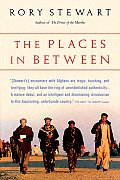 So I've been meaning to write about Rory Stewart's The Places in Between. I thought this was a fantastic book for a lot of reasons -- the writing is wonderful, the story of his walk is enthralling, and the information he gives about Afghanistan is of the type you won't find in most other books about the country.
As I was reading I had a tendency to focus on the adventure parts of it, but I don't want to neglect the political and historical aspects: I learned a lot about the history of Afghanistan, as Stewart gives descriptions of the towns and villages he passes through and tells a bit of their past. He talks a lot about the complex religious heritage of the place, including the Buddhism practiced in ancient times and the more contemporary Islamic history; he explores the remains of the Bamiyan Buddha sculptures destroyed by the Taliban only 9 months before he arrived there. He also criticizes westerners who lament the lost Buddhas but know very little of what's happening to the people alive there today.
I was fascinated by the conversations with villagers Stewart recounts, and the very vague and hazy picture of the west many of the people have -- not so different from the hazy picture of Afghanistan many westerners have, although it's easy, particularly for Americans, to think that the whole world knows everything about us. Many of the people he talked to had never traveled farther than a few miles from their villages. There are very few women in the book, as for the most part they keep themselves separate from the groups of men Stewart moves among, although, interestingly, in the remote mountainous area the Hazara people inhabit, women are allowed a little more freedom. Stewart stays away from overt political statements, but he does criticize western politicians for saying ill-informed things about Islam and westerners in general for not understanding or caring much about the region.
And then there's the adventure:Daulatyar was only fifteen kilometers away and there were probably two hours of daylight left, but I had forgotten how much deep mud and wet snow slowed my pace. I felt muffled in the snow-fog and imprisoned by the rain hood I was wearing. I threw back the hood. I could hear and see again. The day was very silent and the plain seemed very large. The snow driving into my eyes at a forty-five-degree angle made me feel much freer, but my left foot seemed frozen to a cold iron plate.
Stewart insists on walking every inch of the way, even though he must walk in freezing temperatures over mountains, making his way through snow drifts, often in wet clothes. He's sick much of the way, probably having caught a virus in the water and because he doesn't eat very well. He depends on local hospitality traditions, often very reluctantly kept, for his food and shelter every night. At one point he lay down in the snow exhausted and in despair, and even though I knew he made it out of Afghanistan alive, I was afraid he wouldn't get up again. His dog Babur rescues him, barking and whining until he gets up and starts walking again.
Exhaustion and repetition created within the pain a space of exhilaration and control. And at this point, I saw two jeeps, their headlights on, weaving slowly toward us through the fog. They were the first vehicles I'd seen since Chaghcharan. When they reached me, an electric window went down. It was the Special Forces team from the airstrip.
"You," said the driver, "are a fucking nutter." Then he smiled and drove on, leaving me in the snow. I had seen these men at work when I was in the army and in the Foreign Office and I couldn't imagine a better compliment. I walked on in a good mood.
Babur turns out to be an important part of the story; Stewart picks him up in an Afghan village when a family, who had been mistreating the dog, offers to give him away. He is a huge mastiff of one type or another, and Stewart spends much of the book dragging him reluctantly along. Poor Babur causes a lot of trouble; at every village they pass, a pack of dogs comes chasing after him looking for a fight. Stewart is constantly beating back these wild dogs with his walking stick. But Babur is an excellent companion and his life with Stewart is much better although more physically demanding than his previous one.
And, finally, here is an example of the kind of writing you'll find in this book:
Almost every morning, regrets and anxieties had run through my mind like a cheap tune -- often repeated, revealing nothing. But as I kept moving, no thoughts came. Instead I became aware of the landscape as I once had in the Indian Himalayas. Every element around me seemed sharper, the colors more intense. I stared, expecting the effect to fade, but the objects only continued to develop in reality and presence. I was suddenly afraid, uncertain I could sustain this vision.
This moment was new to me. I had not dreamed or imagined it before. Yet I recognized it. I felt that I was as I was in the place, and that I had known it before. This was the last day of my walk. To feel in these final hours, after months of frustration, an unexplained completion seemed too neat. But the recognition was immediate and incontrovertible. I had no words for it. Now, writing, I am tempted to say that I felt the world had been given as a gift uniquely to me and also equally to each person alone. I had completed walking and could go home.
Tuesday, November 28, 2006
The Places in Between
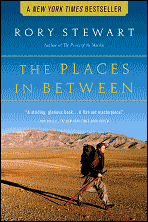 I've begun Rory Stewart's The Places in Between, a book about his walk across Afghanistan starting in January, 2002. It's quite absorbing, and it makes me want to go on adventures. Before this trip, he'd spent 16 months walking across Iran, Pakistan, India, and Nepal, but he'd had to skip Afghanistan because the Taliban refused to let him into the country. After the fall of the Taliban, he decided to give it another try. This is how he begins his Preface:
I'm not good at explaining why I walked across Afghanistan. Perhaps I did it because it was an adventure. But it was the most interesting part of my journey across Asia.
I love that attitude, the "I'm not sure why I did it, I just wanted to" attitude. Because why do anything at all, really? In a lot of ways walking across Asia makes as much sense as anything else anybody might choose to do. So he walked across Asia because it was there and he could.
Can I tell you how much this makes me want to go off on some crazy, senseless adventure?
So far the book is very well written, very absorbing, and full of sentences like these:It was possible that they had simply told Qasim and Abdul Haq to take me outside the city and kill me. No one would notice in the middle of a war. I felt it would be ludicrous to be killed only eight kilometers into my journey and not for the first time worried that when I was killed people would think me foolhardy.
I've read story after story of Stewart walking into strange villages with no idea whether he'll be welcomed or attacked. In his previous walks, people had always taken him in, following customs of hospitality, but in Afghanistan things are not so simple -- while the hospitality custom is still strong, so is fear of strangers in a country so unsettled.
Stewart briefly describes what fills his mind while he's walking day after day. This is the only passage I've come across so far that talks about walking in a more theoretical way; I kind of wish he'd do it more often, but that's not what the book is about (and if you're interested in that subject, I highly recommend Rebecca Solnit's Wanderlust):Before I started, I imagined I could fill my days by composing an epic poem in my head or writing a novel about a Scottish village that would become more rooted in a single place as I kept moving. In Iran I tried earnestly to think through philosophical arguments, learn Persian vocabulary, and memorize poetry. Perhaps this is why I never felt quite at ease walking in Iran.
As an occasional backpacker, I'm interested in what people think about when they spend hours walking (or something similar like running or riding) -- for me, sometimes get in the meditative mood Stewart describes and I agree with him that it's one of the best things about walking.
In Pakistan, having left the desert and entered the lush Doab of the Punjab, I stopped trying to think and instead looked at peacocks in trees and the movement of the canal water. In India, when I was walking from one pilgrimage site to another across the Himalayas, I carried the Bhagavad Gita open in my left hand and read one line at a time. In the center of Nepal, I began to count my breaths and my steps, and to recite phrases to myself, pushing thoughts away. This is the way some people meditate. I could only feel that calm for at most an hour a day. It was, however, a serenity I had not felt before. It was what I valued most about walking.
More on this book later ...
Friday, November 24, 2006
More on The Polysyllabic Spree

So I finished Nick Hornby's The Polysyllabic Spree yesterday, just as I thought I might. The weather never did get nice enough to go on a bike ride, although The Hobgoblin, Muttboy, and I did go on a hour-long walk in the rain at our local woodsy park. After that, it was nice to come home and take a warm shower and stay indoors for most of the rest of the day.
I thought the book was a lot of fun. It's rather addictive; I'd finish a chapter and consider moving on to something else or drifting off to sleep, but then I'd look at the list of books read and books bought that begins the next chapter, and I'd think, oh, just one more. Next thing I knew, the book was finished. Hornby's attitude toward books is infectious. I like how he reads all kinds of different stuff; he writes just as well and just as enthusiastically about a collection of Chekhov's letters as he does about, say, Mystic River.
There were a couple things that bugged me. He has a bit of an attitude about the "literary novel"; he reads them and reads them happily, but he picks on them an awful lot, to the extent that I began to wonder why, and I also began to wonder if it's really so clear just what the "literary novel" is. Is it really a clearly-defined category? When talking about Chris Coake's book of short stories We're in Trouble he says this:
Sometimes, when you're reading the stories, you forget to breathe, which probably means that you read them with more speed than the writer intended. Are they literary? They're beautifully written, and they have bottom, but they're never dull, and they all contain striking and dramatic narrative ideas. And Coake never draws attention to his own art and language; he wants you to look at his people, not listen to his voice. So they're literary in the sense that they're serious, and will probably be nominated for prizes, but they're unliterary in the sense that they could end up mattering to people.Now this strikes me as unfair. Why should the "literary" be that which doesn't matter to people? I think he's got too much invested in this idea of the literary and that he too easily categorizes and dismisses books based on their supposedly "literary" qualities and readers based on their devotion to those qualities, whatever they are. I'm not sure most readers actually read with this category in mind.
Hornby plays around with Hemingwayesque, hyper-masculine posturing about books and writing a little too much for my taste. Books are always in a battle with other books or with other forms of art. This is what's on the book jacket; it's quite funny -- but also ... eh, not my thing:
Books are, let's face it, better than everything else. If we played cultural Fantasy Boxing League, and made books go fifteen rounds in the ring against the best that any art form had to offer, then books would win pretty much every time. Go on, try it. The Magic Flute vs. Middlemarch? Middlemarch in six. The Last Supper vs. Crime and Punishment? Fyodor on points. See? I mean, I don't know how scientific this is, but it feels like the novels are walking it. You might get the occasional exception -- Blonde on Blonde might mash up The Old Curiosity Shop, say, and I wouldn't give much for Pale Fire's chances against Citizen Kane. And every now and then you'd get a shock, because that happens in sport, so Back to the Future III might land a lucky punch on Rabbit, Run; but I'm still backing literature twenty-nine times out of thirty.This is clever, but after a couple of passages about fights among books and the degree of strength or wussiness it requires to write, I start to feel a little alienated. What saves it for me is that Hornby is not actually taking any of it seriously; he's mocking himself a bit, pretty much admitting he's not very good at the Hemingwayesque, hyper-masculine stuff.
I didn't come away with a lot of new books I want to read, although I did pick up a couple of recommendations. One is Gabriel Zaid's So Many Books; I remember Jenny D. has an intriguing post on it. The other is Janet Malcolm's book on Chekhov, Reading Chekhov: A Critical Journey. This seems like a very interesting mix of literary criticism and personal narrative, a combination I like very much.
Wednesday, November 22, 2006
The Polysyllabic Spree
In addition to Alice Munro's Runaway, I recently began Nick Hornby's Polysyllabic Spree, and I'm enjoying it immensely. I remember other bloggers writing about this book enthusiastically, and I couldn't resist. Apparently books about books are what I need these days; I'm reading this book shortly after Sara Nelson's So Many Books -- although I think I'll like Hornby's book better. Books about books are good during times of stress I think -- they are usually fairly light reading, they make good company, and they keep me thinking about things I'll read when I have more time.
Hornby organizes his book into chapters that cover one month's reading. For each month, he begins with a list of books bought and books read, and then he discusses those books for a few pages, not in a whole lot of depth, but very amusingly. Somehow he manages to say substantive things in very short chapters, so that I don't feel he's rushing through his book discussions but I don't get bogged down in details either. Sara Nelson's book had a similar format, short chapters covering her reading over a certain period of time, but I finished her book feeling that the tone was too breezy and that she hadn't really said all that much. Hornby doesn't go into depth, but somehow he captures the essence of his response to a book in a way that's both succint and satisfying. I'm not sure how else to account for why I liked one book and not the other except to say that it might just be a personality thing. In these books, personality is everything.
Side note -- I feel a little bad picking on Sara Nelson in the way that I have over a few posts now. Just recently, Kimbofo had a post asking people if they review books they don't like. I do. I believe it's important to think about what doesn't work in a book and why, and I think such analysis makes book talk everywhere stronger and more interesting. But I do still feel a little bad.
An excerpt from Hornby on rereading and on forgetting:I don't reread books very often; I'm too conscious of both my ignorance and my mortality. (I recently discovered that a friend who was rereading Bleak House had done no other Dickens apart from Barnaby Rudge. That's just weird. I shamed and nagged him into picking up Great Expectations instead.) But when I tried to recall anything about [Stop-Time by Frank Conroy] other than its excellence, I failed. Maybe there was something about a peculiar stepfather? Or was that This Boy's Life? And I realized that, as this is true of just about every book I consumed between the ages of, say, fifteen and forty, I haven't even read the books I think I've read. I can't tell you how depressing this is. What's the fucking point?
It's both depressing and it's true -- it's true for me certainly; my memory of what I've read can be so bad. And here's Hornby doing the numbers on what he's read:I read 55 percent of the books I bought this month -- five and a half out of ten. Two of the unread books, however, are volumes of poetry, and, to my way of thinking, poetry books work more like books of reference: They go up on the shelves straight away (as opposed to onto the bedside table), to be taken down and dipped into every now and again ... And anyway, anyone who is even contemplating ploughing straight through over a thousand pages of [Robert] Lowell's poetry clearly needs a cable TV subscription, or maybe even some friends, a relationship, and a job. So if it's OK with you, I'm taking the poetry out, and calling it five and a half out of eight -- and the Heller I've read before, years ago, so that's six and a half out of eight. I make that 81 1/4 percent! I am both erudite and financially prudent!
I suppose one reason I'm liking the book is that I often think this way myself -- maybe without the humor, but certainly with the obsession.
Wednesday, November 15, 2006
So Many Books, So Little Time
I finished Sara Nelson's book So Many Books, So Little Time last night and although I didn't like it any better by the end than I was liking it when I wrote this, I did find myself fairly contentedly reading on to the end. I'm not sure why the experience of reading the book was positive when I felt unimpressed by it -- perhaps I enjoyed the experience of not liking it or maybe I kept hoping it would get better. Its short chapters certainly kept me feeling that I was breezing my way through it which made it easy to keep going. Perhaps it's that I enjoy book talk so much I'll contentedly read it even when it doesn't impress me.
The things that annoyed me about the book can probably be summed up by Nelson's comment in one of the book lists at the back; here she is commenting on J.M. Coetzee's Disgrace. She finds it:a surprisingly readable novel about racism and family in South Africa, proof positive that prize winners -- this won the Booker -- are not automatically homework.
Why surprisingly readable? Why assume this book would be dull? And why assume prize winners are homework? There's something anti-intellectual about the tone here that bugs me.
But I was struck by one thing she said, and I'd like to get your opinion on it. She talks about the "skip-around method": "the one where you read the end first and then work your way back to the middle, if not the beginning," and she says that "people skip around in books all the time." For the first 30 years of her life, she writes, she wouldn't have considered doing such a thing, but she considers it now because she's stuck in a book she really wants to finish and she thinks that reading the ending might motivate her. She does a survey of her friends and finds that many of them don't read in order.
I can't think of a time when I've done this. Do you skip around? I pretty much subscribe to Nelson's earlier philosophy that:You have to start at the beginning and get to the end before you're allowed to comment on what came in between. There's an order to these things you must respect. Beginnings, middles, and ends are meant to be beginnings, middles, and ends: confuse them at your own peril.
I don't even read collections of stories or essays or poems out of order, or at least not often. I'm probably too devoted to the "rules" of reading, too worshipful of the text as the author presents it to me. But as far as novels go, I don't really want to know the ending until I get there.
What do you think -- is skipping around common?