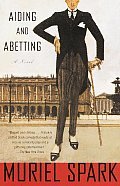
 I finished Muriel Spark’s novel Aiding and Abetting recently. I’m reading it for the Slaves of Golconda; they are discussing The Prime of Miss Jean Brodie at the end of June and each of the members is reading one other Spark book, so this was mine. I figured I could post about it now and add my thoughts on the book during the larger discussion, if they are relevant.
This is a very short book – almost short enough to be a novella – at 165 pages with large print and margins. But so much happens in it, and Spark manages to give you lots of characters and action without creating the feeling that things are rushed and undeveloped.
How can you not like a main character with the name Hildegard Wolf? She is a wonderful character: smart, powerful, mysterious. And also deceitful. She is a psychiatrist with some unusual methods: she spends the first few sessions telling stories to the patient instead of the other way around. The patients love this, for the most part, and she is very successful. She has always had healing powers. In an earlier episode in her life she was a fake “holy stigmatic”; every month she would take menstrual blood and smear it on at least one of the places Jesus was wounded, hands, feet, or side, and people flocked to her for healing. People sent her money in return for her “miracles,” and this is how she survives until she is exposed as a fraud and has to flee. This, of course, makes one wonder about the legitimacy of her status as psychiatrist. She insists that she really did heal some people as a stigmatic, and she really does seem to help her patients, so the book becomes a meditation on the power of belief. Is she so bad for having helped people, even if she did so under false pretenses? All this, by the way, is backstory, sketched in early on before the action begins.
The other part of the story involves two men, both Hildegard’s patients, each of whom claims to be “Lucky Lucan,” an Earl who killed his daughter’s nanny in a failed attempt to kill his wife and then went into hiding for over 25 years. Hildegard, with the help of some of the novel’s other characters, tries to figure out which one is the murderer while keeping out of danger herself. This part of story touches on issues of class: at the time Lucan committed the murder, the story as people told it was mostly about Lucan himself – it was a shocking tale of upper-class “bad behavior” and the friends who aided and abetted his escape. The nanny herself, the victim, was forgotten. As time goes on, Lucan’s high-class friends begin to realize that Lucan is a murderer, not just an Earl who had string of bad luck. They lose their sense of privilege and Lucan begins to lose his friends.
The novel is a mystery story in a number of senses. Which patient is the real Lucan and which is the pretender? Or are they both fakes? How has Lucan survived all those years without getting caught? What is it about Hildegard that people respond to so strongly so that she can perform miracles when they believe in her? Is she, as a fake stigmatic, so different from the fake Lucan? Here is what the novel says about mystery:The case of the seventh Earl is only secondarily one of an evasion of justice, it is primarily that of a mystery. And it is not only the questions of how did he get away, where did he go, how has he been living, is he in fact alive? The mystery is even more in the question of what was he like, how did he feel, what went on his mind that led him to believe he could get away with his plan? What detective stories has he been reading? What dreamlike, immature culture was he influenced by?
Isn’t that the real mystery – what people are like, what they experience, and what shapes them?
The writing here is simple and direct. It’s as though Spark knows she has a complicated story to tell in a limited space and so she must be efficient in her storytelling. The plot moves fast, the words do their job quickly, and yet somehow Spark manages to convey a completeness in those few words. She conjures up an entire world with just a few strokes.
I am now eager to see what The Prime of Miss Jean Brodie is like, and if it is at all similar to this one. Come back for that post on June 30!
Friday, June 09, 2006
Muriel Spark's Aiding and Abetting

Thursday, June 08, 2006
Reader, I married him
If you'd like to read some good writing on bikes and racing, check out this post from The Hobgoblin. Added bonus (besides the fact that he links to me and so you can come right back here after you finish up over there): he's the mysterious "husband" figure I mention occasionally. Go say hi -- he's really quite nice!
Update: go check out this post in particular. You'll love it.
Reader, can you help me?
Mike from Liquid Thoughts has these posts on Flaubert’s Parrot by Julian Barnes, and they reminded me of how much I love that book and others like it. What I want your help with is giving me other examples of similar books, if you can. If you haven’t read Flaubert’s Parrot, it’s about this guy who’s obsessed with Flaubert and who’s trying to find the parrot that sat on Flaubert’s desk, but it’s also about Flaubert himself, his life and writing. It’s very playful; Mike calls it “Barnes’s intellectual game he calls a novel.” It’s really a combination essay and novel, although essay may be too serious a word for it. It’s got a couple different chronologies of Flaubert’s life that play around with the very idea of author chronologies, and it has a chapter about the color of Emma Bovary’s eyes.
I put Vladimir Nabokov’s book Pale Fire in the same category, although I don’t know what I’d call the category, exactly. But I love Pale Fire – a novel about a madman who’s obsessed with a poet. The novel’s form is experimental – it consists of a poem and commentary by the obsessed madman. The story takes place in the commentary itself, which is wildly inventive and funny and revealing. This guy is the ultimate unreliable narrator. The book is about reading itself – the writer/reader relationship, interpretation, imagination.
These two novels are experimental and postmodern, and I like that aspect of them, but I also love the passion in both of them – they are both about a love of literature, expressed in odd and quirky (and sometimes lethal) ways.
They remind of some nonfiction books, too, such as Mary McCarthy’s book Memories of a Catholic Girlhood, which I love. This book takes the form of fairly straightforward essays on McCarthy’s childhood, but interspersed between the essays are meditations on the process of writing the essays themselves, the way memory works and doesn’t work, what is left out, what McCarthy’s siblings remembered differently. She’s playing around with the memoir form, trying to make it more honest, perhaps, trying to make it do more than it usually does, although she does the “usual” memoir thing very beautifully.
Also, I’m reminded of Dave Egger’s A Heartbreaking Work of Staggering Genius, another memoir that is experimental in form and which I loved reading. It’s got a fairly sentimental story as its core, but it’s surrounded by a complicated apparatus – footnotes, revisions, very funny introductions and prefaces, and send-ups of acknowledgement and copyright pages. I think a lot of people thought all that was gimmicky, but I felt it was all part of the emotional current of the book, all part of Eggers’s attempt to capture the essence of his experience. Somehow all that “ironic” (he has a long section saying he’s not being ironic), postmodern stuff came across to me as part of a very earnest attempt to portray an awareness and self-consciousness about his life and his writing – a way to capture life more accurately.
And also, Nicholsen Baker’s book U and I, nonfiction, about Baker’s obsession with John Updike. I loved this book although I have a feeling that it’s the kind of book that in one mood is captivating and in another is annoying. It’s so over-the-top, both in Baker’s obsession with Updike and in the prose – it has some of the longest most complicated sentences with obscure vocabulary you’ll find just about anywhere. I found it irresistible; Baker makes you love Updike, even if you don’t. I don’t love Updike particularly, but I’m willing to because Baker does.
These are books I’m tempted to read again, just so I can have the fun of blogging about them while they are fresh in my mind. I would try to make you love them too. They all fit in one category for me, although I’m not sure what I’d call it – experimental, self-reflexive books that take literature and reading as their subjects, and do so with passion. Can you think of a label? Even more importantly, can you please give me more examples?
Wednesday, June 07, 2006
At the races: on cycling
I've been riding in a series of races every Tuesday night for the last three weeks. They are held less than two miles from my house, so on Tuesday evenings my husband and I will roll out of the house on our bikes and ride over. When people ask me how I did, I have to find some way of telling them I'm happy with my performance, even though, in truth, I didn't do very well. "I did pretty well -- for me..." "I did badly, but better than the week before..." "I'm happy with how I did ..." And then we have this discussion of how what really matters is how I feel about the results, that I'm having fun and am getting in great shape. Yeah, yeah.
Last night I actually did pretty well -- I finished the race with the pack for the first time. The previous two weeks I stayed with them for 2/3 and then 3/4 of the way (they ride for about an hour) then had to drop out because I couldn't maintain a 25-mile an hour speed and an average heart rate of 173 bpm or so. But this time I was with them up until the very last bit of it.
When I arrive, I look around at the other racers and see all these people, almost entirely men (the first two races a couple other women rode but last night I was the only one), who look so strong, and I think, no way. This is silly; I can't compete. It must be something about seeing all those men with their low body fat percentages and their obviously rippling leg muscles that intimidates me. I've got big leg muscles, all right, but you don't see them unless you look really closely, covered as they are with my feminine layer of fat. But you really can't tell how someone will ride based on how they look. People who look a bit overweight will end up having some super-powerful muscles and they will leave you behind, or the scrawny guy who has the tiniest-looking muscles will fly up the hill like you wouldn't believe.
I dread these races every week. Every Tuesday I think, really, I'd rather just stay home and read. I think, oh, I'll just take it easy this week. I really don't feel like riding hard. My day was too stressful and I just need a rest. I warm up for a race and have no energy; I'm sluggish and can't work up speed. But something happens when I get really warmed up and the race begins -- I get energy, and by the end of the race, I have a lot more energy than I did at the beginning, even though my muscles are very glad I've stopped.
When I did training rides with my old cycling club, I'd do this obnoxious thing where I'd say to everybody, oh, I'm going to take it easy today. I'd get that lethargic feeling, and I would know it was going to be a slow ride. But then I'd get energy from somewhere, start riding faster and working harder, and people would get annoyed with me because I'd be pushing the pace when I'd promised not to. Actually, I'm not the only one who did this -- our conversations before the race would be about how everybody was tired that day and was going to take it easy. We may have believed it in the moment, but everything changed once the ride began.
All this tells me that I probably shouldn't listen to those feelings of dread and weariness when they come. Or maybe I should listen to them but not believe them. I feel that dread before a lot of difficult things I have to do -- it's similar to the sense of dread and weariness I will often feel before I teach a class. But once the class begins, I get energy from somewhere and I end up having fun.
Difficult things like bike races don't sap my energy: they create it. There is nothing worse for me than sitting around all day reading a book. I will feel weary and disgruntled by the time I go to bed. A perfect weekend day is really something like riding a race or doing a hard training ride in the morning, and then coming home, with new energy and the feeling I've accomplished something, and then sitting down and reading for as long as I like.
Speaking of reading, I recently finished Muriel Spark's novel Aiding and Abetting, which I will post on soon.
Tuesday, June 06, 2006
More on diaries (commenting on the comments)
So Danielle from A Work in Progress wrote this comment yesterday that intrigued me:I have always been afraid to keep a diary. Either the contents would be so boring that anyone reading it would be bored to tears, or so private that I would hate for anyone to read it. Do you think diarists really do keep these journals only "for their own eyes"? Or do you think a part of them writes for some later unknown reader? And does that affect how they write and the contents?
I have tried a lot of times to keep a private journal. I’d succeed for a while, and then would write less and less and finally stop entirely. I always blamed my laziness for this. I was partly right, I suppose. Now that I think about it, I’m lazy about journal writing in the same way I’m lazy about cycling, which is to say, not lazy at all if I have the right motivation. If my husband didn’t ride, I probably wouldn’t either. I can consider this a failing, or I can just realize that riding my bike as much as I do is hard, and be thankful my husband rides too. And about the journal – I wonder if I didn’t keep it up because I had to do it by myself, and if, now that I’ve turned to blogging, I’m more likely to keep up the blogging because I have you all around to motive me. I admire people who can write journals regularly and not succumb to my kind of laziness, but I’m not like that.
But back to Danielle’s comment – I wonder if part of my problem with writing a journal came from an uncertainty about audience. Do diarists write for themselves alone? It seems to me that all diarists must have in the backs of their minds at least the possibility that people will read them, sneaking peaks while they are alive or reading them in some slightly more legitimate way after they are dead. I always knew – not that I’d become famous and people would read my diary wanting to understand the “real me” better – but that someone I knew might read the thing. That made any serious personal revelations difficult. If I tried to forget that and just write for myself, I would get self-conscious about it. It was me there, trying to put me on the page, with me as the reader, and that was just too much me around. Writing felt strained and awkward. And re-reading what I wrote was painful. I never found a way to be honest and never found a voice I was happy with, which is what I think I wanted from the journal. I’m curious what you real diarists out there make of this.
So I’m wondering if blogging might help me solve my audience problem. I mean, I’m not planning on writing anything all that personal (don’t worry!), so I won’t get that satisfaction out of the blog, but I will be able to write my thoughts on books and this and that and have an audience out there besides me. You all will help me legitimize my writing to myself. Isn’t this weird? One would think dealing with the issue of audience would be easier in a private journal than a public blog, right? I thought I would resolve what I thought about Danielle’s comment in this post, but I end up more uncertain. I guess what it comes down to is that for me, knowing there are readers out there does affect what and how I write, and I’m better off writing a blog where I can deal with that directly than a diary, where the audience issues overwhelm me.
Maybe this post is just a not-so-subtle way to guilt you into reading me?
Monday, June 05, 2006
On Virginia Woolf
In the comments to my previous post, people got to wondering what they reveal about themselves in their blogging – not when they are writing about themselves but precisely when they aren’t. It’s impossible to know what you are communicating when you write anything, which strikes me as the scary thing about writing for the public and the thing that makes it worthwhile.
The best you can do is to read your writing after a lapse of time – then it’s a little like reading the work of a stranger, and you get a better sense of the quality of what you’ve written. I tell my students to write their papers enough ahead of time so that they can set them aside for a while and look at them fresh. I don’t think they listen to me though. Reading your writing after letting time go by can be painful. Here’s Virginia Woolf writing in her diary about re-reading it:I got out this diary, & read as one always does read one’s own writing, with a kind of guilty intensity. I confess that the rough & random style of it, often so ungrammatical, & crying for a word altered, afflicted me somewhat. I am trying to tell whichever self it is that reads this hereafter that I can write very much better; & take no time over this; & forbid her to let the eye of man behold it. And now I may add my little compliment to the effect that it has a slapdash & vigour, & sometimes hits an unexpected bulls eye.
I like the way she describes the future Virginia Woolf who will read the diary once again as a different self – when returning to an old diary, who exactly are you reading? She goes on to discuss the value of diary writing:But what is more to the point is my belief that the habit of writing thus for my own eyes only is good practice. It loosens the ligaments. Never mind the misses & the stumbles. Going at such a pace as I do I must make the most direct & instant shots at my objects, & thus have to lay hands on words, choose them, & shoot them with no more pause than is needed to put my pen in the ink. I believe that during the past year I can trace some increase of ease in my professional writing which I attribute to my casual half hours after tea.
I wonder about this myself – how diary writing, or for me, blog writing, will affect other kinds of writing I do. I think the daily practice is invaluable. I’m curious – for those of you who write other things besides blogs, what is the relationship between the kinds of writing you do? Does one affect the other? Then Woolf asks:What sort of diary should I like mine to be? Something loose knit, & yet not slovenly, so elastic that it will embrace any thing, solemn, slight or beautiful that comes into my mind. I should like it to resemble some deep old desk, or capacious hold-all, in which one flings a mass of odds and ends without looking them through. I should like to come back, after a year or two, & find that the collection had sorted itself & refined itself & coalesced, as such deposits so mysteriously do, into a mould, transparent enough to reflect the light of our life, & yet steady, tranquil composed with the aloofness of a work of art.
Sigh. Do you see why Woolf is one of my favorite writers? I love the idea that what she writes will take on meaning over time, even though when she first wrote, she was writing only what mattered in the moment. But what seems disconnected, disjointed, fragmentary at first, over time can come to seem connected, can begin to form a coherent story.
Is there anything more one can hope for from one’s daily writing?
Perhaps she contradicts herself here: what was at first a contemplation of the changing self becomes a hope that the self will, over time, begin to cohere. But perhaps she is merely playing with the tension between the disconnected events of life, the shifting self, and the desire to see wholeness.
Sunday, June 04, 2006
Privacy
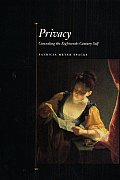 So I began a new book called Privacy: Concealing the Eighteenth-Century Self by Patricia Meyer Spacks -- I chose it because I was looking for interesting books about the eighteenth century, but then I began to realize that the topic is perfect for me to think about right now, having begun this blog only a couple months ago, because I'm sorting through what I think about privacy in a very direct way every time I write a post. Since this book looks at privacy through the lense of literature, largely the novel although including other genres, I'm afraid, reader, that you will be subjected to more quotations about Samuel Richardson. But not today.
Oh, sorry -- I just found the quotation I wanted to give you and it's about Clarissa. Okay, you will be endlessly subjected to quotations about Richardson, and I guess you'll have to deal with it. This is Spacks talking about the contradictions in Clarissa's attitude towards privacy:Desiring to slide through life unnoticed, she resolutely separates herself -- physically, as much as she can; psychically, almost completely -- from others ... Yet all eyes are upon her: the eyes of all she encounters, but also, by her prearrangement, the eyes of all who survive her: not only family and friends, but potential readers of the book to be compiled by Belford, for which she also arranges. She wants to slide through life unnoticed; she also wants all eyes upon her. She wants privacy; she wants fame.
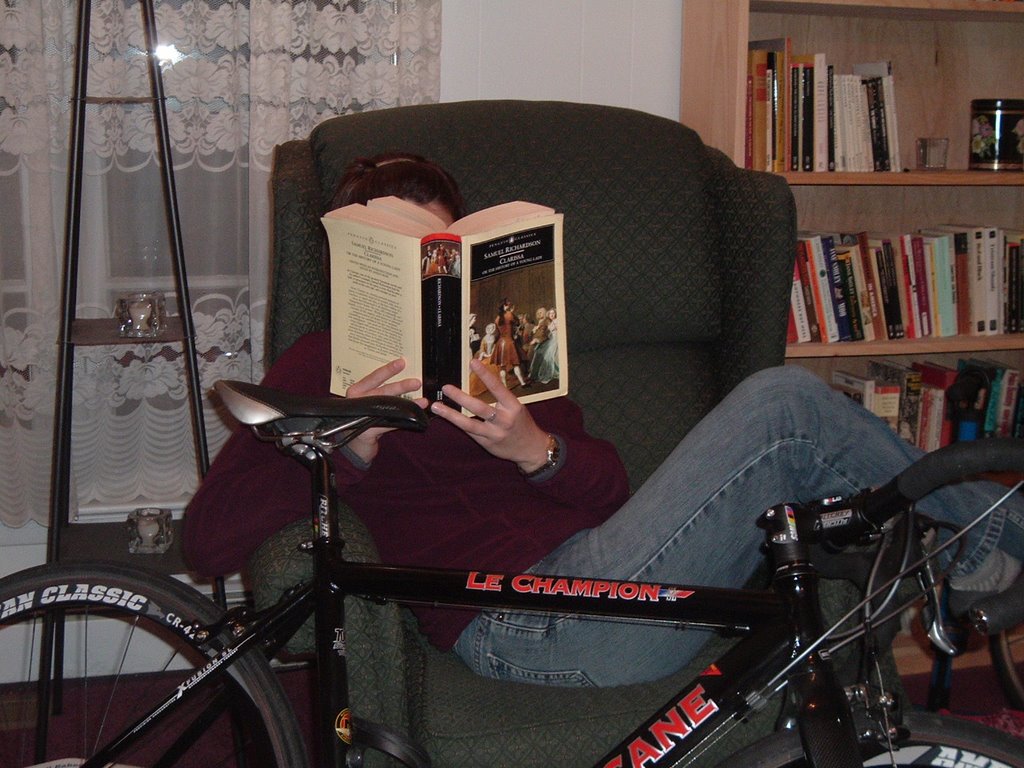
This is quite the paradox -- she wants to be alone and wall herself off from others but she arranges her own exposure through writing and reading; she wants privacy and fame both. It sounds a bit like blogging, doesn't it? I write about exactly what I choose to write about, including some personal details and excluding others -- a lot of others -- and thereby I'm preserving my privacy. Sort of. Having a blog means that I'm violating my own privacy to some extent (if such a thing is possible -- if I'm the one doing the violating, is it violation?). I'm both hiding and revealing myself. The thing that amuses me about the picture I put up of myself on the blog a while back is that it's self-revelation -- but not really. It's Clarissa herself who's hiding my face. Clarissa writes and writes and writes -- the novel is made up of letters, a large number from Clarissa herself -- but her character is in a lot of ways still obscure. Writing about oneself can be a way of revealing oneself, but, paradoxically, of shielding oneself too.
I recently came across this post from Tales from the Reading Room, where Litlove describes why she blogs:If I did believe that identity was in fact composed of a myriad assortment of small narratives, and that our sense of self changed with the ebb and flow of the stories we told, wouldn't it be intriguing to watch such a dynamic in action?
The wording here is interestingly ambiguous -- who is intrigued? Watching the "ebb and flow of the stories we told" is intriguing for the writer and for the reader both, the "we" of Litlove's phrase. The writer is discovering things as she writes just as the readers is discovering as she reads. I would add that what's intriguing is not only watching the ebb and flow of a changing and fragmentary identity, but getting the sense of what is not said as well -- of the person that lies behind the posts, undescribed and unrevealed. Making writing public somehow enhances the feeling of depths unexplored, kept private.
Saturday, June 03, 2006
Book reviews
Thanks to Ella and her post introducing some new book bloggers (including me -- thanks again Ella!), I went over to check out Eve's Alexandria, a cool blog with lots of great book reviews. I saw this post on Zadie Smith, her book On Beauty, and Victoria's review of it. The story is that the review was negative, people left comments agreeing with the negative response, and Zadie Smith, or someone claiming to be Zadie Smith (impossible to tell), left a comment defending herself -- not defending the novel per se, but clarifying that she doesn't consider herself "the great young genius of the contemporary English novel," a phrase from one of the comments. Victoria's follow-up post is a discussion of negative reviews and the responsibilities of a book reviewer.
Victoria argues that a person has a responsibility to respond to reading honestly. She says:I’ve often heard it said that a citizen’s democratic duty is to question its government and to speak out when said government loses its way (that way, inevitably, being subjective). As I see it this is also a reviewer’s duty: to engage with the written word thoughtfully at a visceral level, to question its values and its purposes, and then to *write* back.
I remember reading at least one blogger arguing something different, although I can't remember who it was -- that in a world where (some would argue) reading is a threatened activity, where getting published is difficult, where writers should be encouraged, the best response when one doesn't like a book is to keep quiet about it. To ignore a bad or mediocre book, in this view, is to help ensure that it disappears and that better books get attention. The idea here isn't to be false to one's opinions, but simply to keep quiet about the negative ones.
Ultimately, I think, I come down on Victoria's side -- that it's best to say what I think, positive or negative or mixed, and thereby take part in and encourage a debate. I'm no fan of scorching Dale Peck-type reviews that are more about showing off one's ability to insult than about real engagement with a book, but I think lively debate about books is the best way to keep interest in reading alive. Only the kind of full engagement with reading that includes voicing negative opinions as well as positive ones will keep that debate going. Victoria says it beautifully:I want to be energised by my reading. If we don’t write back with all our energy how will they, the novelists and the future novelists, know what we’re looking for?
I would, however, freak out if I thought an author had read my negative response to a book. I don't want to discourage any writer. I want to make everyone happy. Zadie Smith's comment -- if it really was her -- sounded pretty hurt. This is difficult. But I think the value of analyzing one's response, be it positive or negative, outweighs the hope of encouraging reading by focusing on the positive (unless we're talking about a book by a friend -- in that case, preserving the friendship is more important).
One could also argue that negative reviews should have some kind of larger point to them -- the negativity should serve the purpose of illuminating what it is that makes good writing or how the writer could improve. This argument is stronger, but I'm still not fully convinced. I guess I don't like dictating the terms -- for myself or for others -- under which negativity is acceptable. I don't think we need to treat books as delicate things that need preserving.
The subject is complicated by the fact that this is a blog and not a formal book review site -- I think that the responsibility to be honest about negative opinions is greatest for someone who is paid to write reviews and those reviews get published in places where people look to get honest opinions about books (yes, maybe I'm naive -- I know things don't always work that way, but that's the idea). Here, it's not my "job" to give my best assessment of a book -- no one's paying me to do it -- people who happen to read the blog have no reason to trust me or to think they are getting my full opinion. I choose what I want to write about and what I want to say about it and I don't pretend to be complete or completely objective about anything.
But still -- if another book blogger wants to keep quiet about books she doesn't like, that's fine, but I'd prefer to think through -- by writing about it on my blog -- why I like and don't like certain things, recognizing that my view is subjective and others might not agree. I think to expend energy on books in this way ultimately helps out all writers.
Friday, June 02, 2006


On Poetry
I've had trouble, at times, fitting poetry reading into my life -- I've always wanted to be the kind of person who reads and appreciates poetry, but the image of myself as a reader and the kind of reader I actually am don't always match. And it's not just an image thing -- I've truly wanted poetry to matter to me. Waking this Morning Dreamless After Long Sleep
I think part of my problem with reading poetry has been that I've felt I needed to read a bunch all at once -- to make my way through a book of poems in a relatively short time. I don't know why I felt that way. Maybe it has to do with getting impatient if I'm in the middle of a book for too long.
At any rate, I'm trying not to care if it takes me months to read through a book, and to read poems only a couple at a time, for short periods of time here and there. If I try to read a whole bunch of poems at once, I feel like I'm not absorbing them and that there's no way I will remember them. Even reading only a couple at a time, I may not remember them, but I'm more likely to. If I set out to read only two or three poems at a time, then I'll spend more time with each one, and really feel like I'm engaging with them.
But that leads me to the other problem I have with reading poetry: I'm uncertain about how long to spend with each one. For me, it's like looking at art in a museum -- I get self-conscious about how long to look at each piece and when to move on. I begin to think about how long I've been standing there and how much longer I should stand there, rather than thinking about the art itself. With prose, while I may re-read a passage here and there to understand it better, the expectation is that a person will read through it once. But with poetry, obviously, re-reading is much more important.
I'm in the middle of Jane Hirschfield's book Given Sugar, Given Salt, and I've found that she has many poems that consider the relationship of writing and life -- how the page can merge with one's experiences in the world. Here is one example. I like the image she has of memory as a book where the ink bleeds through the pages and the idea that even our blank pages -- or new days -- are already written on by our previous experiences:
But with this sentence:
"Use your failures for paper."
Meaning, I understood,
the backs of failed poems, but also my life.
Whose far side I begin now to enter --
A book imprinted without seeming reason,
each blank day bearing on its reverse, in random order,
the mad-set type of another.
December 12, 1960. April 4, 1981. 13th of August, 1974 --
Certain words bleed through to the unwritten pages.
To call this memory offers no solace.
"Even in sleep, the heavy millstones turning."
I do not know where the words come from,
what the millstones,
where the turning may lead.
I, a woman forty-five, beginning to gray at the temples,
putting pages of ruined paper
into a basket, pulling them out again.
Thursday, June 01, 2006
More meta-blogging
I was excited to read this post from Kate's Book Blog. Yes, she quotes me in this post, but that's not why I was excited -- it's because the part after she quotes me is so interesting. She talks about travel writing first of all, and describes two kinds: travel writing that foregrounds the author's own experience as well as the places traveled through and travel writing that tries to be objective and authoritative by removing the presence of the author. Kate prefers the former kind, and I fully agree -- it strikes me as more honest if an author doesn't pretend to be objective, since this, when it comes down to it, is impossible. How is this brief meditation on travel writing relevant to the practice of book blogging? My favourite litbloggers travel into books with an open mind and send back dispatches. They don’t purport to describe the book in objective fashion; they write about their encounter with the book revealing something about their previous reading, their preconceptions, their aesthetic sensibilities along the way. If it’s a return visit rather than a first encounter, they may reflect on shifts in their perception of the terrain this time around. And, most important, rather than expecting fellow readers to take their word as final, they encourage us to pick up the book and see it for ourselves.
One of my favorite travel books along these lines is Mary Wollstonecraft's Letters Written During a Short Residence in Norway, Sweden, and Denmark. Here Wollstonecraft has a lot to say about what she sees in these countries, but she also writes a lot about her mental and emotional state as she is traveling and thinks about how this state affects the observations she makes. Before she left on the trip, she found out her lover had been unfaithful and she made a suicide attempt, and she doesn't write about these details in the text, but she alludes to sorrow and heartbreak. It's a short, beautifully-written, evocative book.
But Kate also makes a point about how blogging can be like travel writing:
Litblogging here is a "journey" through books, reported on subjectively, with self-awareness and without the illusion of objectivity -- I like that. Aunt B. has something to say about this as well, from another angle:That's what I love about blogging--you throw out some ideas, you get some feedback, you come at those ideas from a slightly different way next time, you get more feedback. Writing in this setting isn't about a finished, set, product, but about circulating ideas and clarifying what you think. I love to blog because, when I write, I know you, whoever you are, will read it.
Here, blogging is exploration, or travel, as well, this time with input from readers, and it's about remaining open to change and revision. Ideas keep circulating (travel!) rather than settling down into something finished.
Wednesday, May 31, 2006
Just a little more on Tyler
One more post on Anne Tyler
I finished Digging to America last night and have just a couple more things I want to say about it. If you're planning on reading this book, you might want to skip the post, although I'll warn you when I'm about to give something big away about the plot.
First of all, for those of you who are planning on reading this book, notice the "binky party" that happens near the end. Please, please, under no circumstances, ever hold a binky party for your child.
I liked this line from another part of the book:Maryam stood in the kitchen doorway with a salad bowl in her hands and wondered if every decision she had ever made had been geared toward preserving her outsiderness.
As someone who can think of herself as an "outsider" and who likes to stand outside of things, I was touched by this character and by her realization. Maryam's way of negotiating this dilemma of insider- and outsiderness is central to the book, and it makes sense to me that it takes her a while to understand that she may have been reinforcing her outsider status without fully realizing it.
But I was uncertain what to think about a couple of things Maryam contemplates (and stop reading here if you don't like to know much about a book before you read it). She says at one point:Oh, the agonizing back-and-forth of romance! The advances and retreats, the secret wounds, the strategic withdrawals!
Wasn't the real culture clash the one between the two sexes?
Later, when she is thinking about relationships, she says:Sometimes lately she felt as if she had emigrated all over again. Once more she had left her past self behind, moved to an alien land, and lost any hope of returning.
Now, I'm not sure I buy this equation of relationships with emigration and with culture clashes. On the one hand, it's a cool metaphor for what it's like to enter a relationship with someone -- it's about leaving behind one's old world and entering a new, about adapting one's life -- one's culture -- to enter into someone else's, about having an experience with alienness and otherness.
But these lines, and the events that happen right at the end of the book, seem to me to collapse love with immigration/culture clashes in a way that overly simplifies what it means for a person to take on a new culture and nationality. I don't think the real culture clash is the clash between the sexes. This seems to me to privilege the experience of gender above other kinds. At the very end of the book, Maryam makes a decision to engage with the Americans who have entered her life instead of blocking them out, and it becomes a question of whether she will stay in her relationship with Dave, who seems to her to be the quintessence of Americanness. And so she resolves her questions about culture and national identity by deciding to keep the relationship going. This seems like an interesting way of solving the problem -- what could be a more decisive way of changing and adapting than falling in love with an American? -- and yet something bothers me about this narrative solution. Can cultural clashes get solved solely through personal relationships?
I'm definitely not being clear here. I guess, to a degree, problems of immigration and cultural differences can work themselves out, for individuals, in the context of family and love, but the novel's ending seems to imply that this is the best and maybe only available context. This seems to me to be untrue to the rest of the book, which did a good job of showing how politics and family interweave without collapsing the two areas into one another. The personal is political, yes, but are all politics personal?
Tuesday, May 30, 2006
More on Anne Tyler
I'm about 50 pages from the end of Tyler's latest novel Digging to America, and one of the things I am liking about the book is how politics of various types are an important part of the novel, but are in the background in a way that strikes me as realistic -- at least realistic for some. Tyler shows how politics shapes people's lives -- both specific historical events and the more nebulous "identity politics," but she does it in a muted kind of way. Politics and history are sometimes topics of conversation, but more often, political forces lie behind the thoughts and actions of the characters and the reader is left to figure out how the characters are affected by them.
The most direct entrance of politics into the novel concerns events in Iran. One of the main characters, Maryam, the grandmother of one of the two adopted babies at the center of the novel, thinks about how the Iranian community in America was divided by their different opinions of the Shah -- she was friends with many other Iranians until the question of whether one is loyal to the Shah or not began to rip the group apart. From this point on, she lives even more isolated from her past.
September 11th happens during the timeframe of the novel, but it doesn't get a description -- it surfaces mainly as a matter of increased airport security and the annoyances this causes. One of the Iranian characters describes the fear other people manifest in the presence of anyone of middle-eastern descent. Dave, another grandparent, gives an emotional speech to Maryam about how he doesn't like being grouped with other "ugly Americans" -- how he's affected by the stereotype -- and Maryam retorts, "Whereas we Iranians, on the other hand ... are invariably perceived as our unique and separate selves." This is Dave experiencing both the discomfort of being a victim of stereotyping, and the realization that, as angry as this makes him, he can't expect everyone else to feel his outrage.
Everyone in the novel is affected in some way by this kind of racial and ethnic stereotyping. Maryam is invested in the idea of herself as a "foreigner," and because of this she has trouble opening up to her American friends. She is naturally introverted, but this status as "foreigner" feeds into and exaggerates that characteristic. Bitsy tries hard to teach Jin-Ho, her adopted daughter, Korean customs to help her learn about her birth country, but she finds this is more complicated than she expects, and when Jin-Ho grows up a bit, she resists this training. Sami was born and raised in America and he refuses to speak Farsi, although he can understand it, but at the same time he takes great pleasure in mocking Americans as though he weren't one himself, to the amusement of the Iranians present. All of Tyler's main characters are involved in some kind of effort to figure out their identity and to negotiate the various elements that go into it: nationality, gender, class, personal history. It is in describing these negotiations that Tyler excels.
Monday, May 29, 2006
Funny tan lines: a cycling update
This is one of the major problems of being a cyclist -- that you spend the whole summer with very sharp tan lines right where your cycling clothes end. I've already got a dark line on my upper arm, a series of dark lines above my knees, at the places my cycling shorts of varying lengths end, and a dark line above my ankle where my socks end. A large percentage of the time I spend outside I spend on my bike, so I'm stuck. I have this problem where I'll apply sunscreen, and apply it when I have my cycling clothes on, so I get it right, but then as I ride, the shorts will ride up a bit and the short sleeves on the jersey will pull up a little bit, and I'll have missed a section of skin and will end up with this sunburnt patch of an inch or so on my arm and thigh.
The funniest tan lines, though, are the ones on my wrist and hand, where my cycling gloves end. I have a super-sharp line on the thumb side of my wrist, since I ride mostly with my hands in a sideways position, with the thumb facing up. And then as summer gets going, I'll develop lines on my fingers, since the gloves end just before they reach the first knuckle. And, depending on the kind of gloves I have, I sometimes get a little dot on the back of my hand where the velcro strap doesn't quite cover the skin fully. I'm already developing this dot on my left hand, although for some reason I don't have one on my right. I guess my gloves aren't quite the same. If you have gloves with mesh on the back, you will end up with a whole series of dots across the back of your hand. Some cyclists will develop a line across their forehead where their helmet goes, and maybe lines across the neck where the helmet straps cover.
Sigh -- the sacrifices I make for my bike. So today is devoted to fixing this situation -- sitting outside in the hopes that my hands and ankles will get some sun.
Yesterday I went on a 50-mile ride, my longest of the season by far; I'm working my way up to being able to do a 100-mile ride by late August. I like to ride centuries -- organized rides with set routes and food and water supplied along the way -- of (logically) 100 miles, although there are always shorter options for those not wanting to ride the 6 or 7 or 8 hours it takes to do the full thing. The longest 1-day ride I've ever done is 130 miles, about 1 1/2 years ago, a ride that taught me a thing or two about endurance and pain. For some reason, the pain doesn't keep me away -- I suppose it's the sense of accomplishment and the feeling of strength that keeps me doing it again and again.
Sunday, May 28, 2006
On Pamela
Before I put away my novel history book, Licensing Entertainment, there is one more thing I want to say about it. In his chapter on Samuel Richardson, William Warner makes some big claims for the importance of his novel Pamela. He describes the fight over Pamela: critics and readers argued heatedly over whether she was as virtuous as she claimed to be. Warner says that Pamela and this critical conflict was partly responsible for our way of reading character:It is at this point that English readers start engaging in the sort of sympathetic identification with and critical judgment of fictional characters that will lie at the center of novel reading from Richardson, Fielding, and Frances Burney through Jane Austen, George Eliot, and Henry James … The following are some of the interrelated elements of this new practice of reading: Pamela’s readers “read through” the words and ideas of the novel’s eponymous heroine in order to assess her character to discover whether Pamela is what the text’s subtitle declares her to be – a personification of virtue – or its reverse, a mere sham. By conferring on a character in a novel some of the free-standing qualities of a real person, and insisting that judgments of literary character reflect as much light on those who judge as they do on the judged, both sides in the Pamela wars confer an unprecedented moral seriousness upon the evaluation of fictional characters. The strife around Pamela draws readers into particular practices of detailed reading: selecting what to read so as to emphasize one thing instead of another; being provoked by incomplete descriptions; filling out the picture to one’s own taste; using one’s imagination to read between the lines; discerning the supposedly “real” intention of the author; and, finally, distinguishing the “proper” from the “improper” in a text, in order to judge whether a text is “readable” or “unreadable.”
Isn’t it surprising, if you buy Warner’s theory (and I see no reason not to), that our way of reading characters – seeing them as real people and judging them on realistic and moral grounds comes out of the eighteenth century and particularly from Pamela? From a story about a young girl resisting rape? Isn’t the history of the novel fascinating? Don’t you want to go read some eighteenth-century novels now?
I’ve said this before, but I very much like the idea that our ideas about reading that seem so natural – that we want to identify with a character, for example, and that we talk about characters as though we might meet them in person – have a history that isn’t so very long. If you buy Warner’s theory, that is.
It comes down to the question of whether Pamela is really as innocent as she makes herself out to be. For the other side of the story, read Henry Fielding’s Shamela, which is quite funny. I read Pamela twice, for two different graduate school classes, and I can’t say the book follows any of the “rules” of good fiction that we might come up with today – the structure of the thing is terrible – but that’s judging by contemporary standards which didn’t exist at the time. Pamela the character can be infuriating and the book can get boring, especially at the end, but as far as a book that is culturally significant and that can teach you something about eighteenth-century culture, you can’t go wrong with it.
Saturday, May 27, 2006
Book Groups

I'm completely new to book groups, and now I am participating in two of them! One of them is the Slaves of Golconda, an online book group, for which I'll be reading Muriel Spark soon, and the other is a brand new group -- what should I call it -- in-person? face-to-face? the regular, old-fashioned kind? the kind where you meet in someone's house and have coffee and dessert? We're starting small with my husband and me and one other couple, and if it goes well, we might expand it later. The idea is to keep things low-key and without any showing-off or intellectual posturing. For that reason, we're being careful about whom to ask -- we want it to be fun, and one person with the wrong attitude could throw the discussion off.
So our first book is Anne Tyler's new novel Digging to America. I'm about 100 pages into it right now, and it's a good read. Tyler is so very skilled at capturing family dynamics -- the "little" interactions that aren't little at all, but are the things that make up much of the substance of our lives. So far, the narrative has been a series of parties to celebrate the two little Korean babies two families -- both American but one white and the other of Iranian descent -- have adopted.
Now that I think about it, this structure is remarkably similar to Alan Hollinghurst's novel The Line of Beauty (which I posted on here), in a funny kind of way, since the novels are in most cases very, very different. But Hollinghurst's novel, too, was basically a series of parties one after the other, which offers an author a chance to bring a whole bunch of characters together and have them interact in ways that reveal who the characters are and move the plot along. And both novels chart the intersections between politics and family life. Tyler so far hasn't given nearly as much political detail as Hollinghurst did, but it's there for both of them -- in Hollinghurst's case, it's Thatcherite Britain, and for Tyler, it's the political and religious upheaval in Iran. And both novelists give exquisite detail about tone of voice, significant looks, hurt feelings, "friendly" competition and aggression, unexpected alliances.
And a bit of satire too -- Tyler's novel is funny in places, especially about Bitsy and Brad, the "all-American" couple, Bitsy a hippy type with very strong opinions about how children should be raised and no fear about sharing them. In an early scene Bitsy and Brad have a "raking party" where they invite the other family over to help them rake the lawn. Hmmm. Should I start holding "housecleaning parties"? Yeah, friends, come on over and help scrub the kitchen floor! If you're lucky, you'll get to clean the toilet! It'll be great fun!!
Anyway, more on Tyler later.
Friday, May 26, 2006
Colette's hair
I finished Colette's My Mother's House and Sido last night; if you aren't familiar with it, the short chapters in My Mother's House were published serially first and then collected in book form in 1922, and Sido was published seven years later. Sido is made up of three sections, one each about Colette's mother, father, and siblings.
I enjoyed the book very much and recommend it -- I do think it should be read slowly. I read it a bit fast and sometimes felt like it was rushing past me and I was missing things. The writing was beautifully lyrical, which is a phrase that would turn me off if I read it in someone else's review, but in this case the writing worked for me. The short chapters are like prose poems, each capturing a story or a character or a mood. They got me interested in reading a biography of Colette; there are things hinted at in this book that I'd like to know more about -- Colette's conflicted feelings about femininity and sexuality, in particular.
Here is Colette writing about her hair:I was twelve years old, with the manners and vocabulary of an intelligent, rather uncouth boy, but my gait was not boyish because my figure already showed signs of development, and above all because I wore my hair in two long plaits that swished through the air around me like whips. These I used indiscriminately as ropes from which to hang the picnic basket, as brushes to be dipped in ink or in paint, as whips for a recalcitrant dog or as ribbons to make the cat play. My mother wailed to see me maltreat these two golden brown thongs for whose sake I was daily condemned to get up half an hour earlier than my school-fellows. At seven o'clock on dark winter mornings I would fall asleep again, sitting before the wood fire, while my mother brushed and combed my nodding head. From those mornings I date my invincible hatred of long hair.
As someone who would head out in sub-zero weather with wet hair rather than wake up ten minutes earlier to use the blow-dryer, I sympathize. I love her impulse to think of her hair as a whip before she thinks of it as an object of beauty or a source of attention. She ends the paragraph this way:Long hairs would be discovered tangled in the lower branches of the trees in the garden, long hairs attached to the cross-beam from which hung the trapeze and the swing. A pullet in the barnyard was supposed to be lame from birth, until we ascertained that a long hair, covered with pimply skin was bound tightly round one of its feet and atrophying it.
Could she be clearer about seeing the conventions of femininity as crippling? However, the next paragraph takes another turn:There is just one moment, in the evening, when the pins are withdrawn and the shy face shines out for an instant from between the tangled waves; and there is a similar moment in the early morning. And because of those two moments everything that I have just written against long hair counts for nothing at all.
Colette both loves and hates her hair, she feels it holds her captive, but she is also captivated when it's let loose. It can cover and hide her face, but the moment of her face "shining" through the dangling hair somehow compensates for everything. She is oddly removed from this passage; it's not "my shy face" but "the shy face" that shines through, as though she can appreciate her own beauty only if she pretends it is someone else's.
Colette's chapter called "Maternity" is similarly conflicted. Her sister makes an unfortunate marriage and is estranged from the rest of the family; when they find out she is pregnant, here is Colette's response:I had ceased to think about her, nor did I attach any special significance to the fact that just at that time my mother began to have attacks of nervous faintness, nausea and palpitations. I only remember that the sight of my sister, distorted and grown heavy, filled me with still more embarrassment and disgust.
When her sister is giving birth, her mother, kept from her side because of the family feud, goes over to the sister's house and lingers outside, listening for sounds that would tell her what is happening. Colette writes this remarkable passage:A second cry, pitched on the same note, almost like the opening of a melody, floated towards us, and a third .... Then I saw my mother grip her own loins with desperate hands, spin round and stamp on the ground as she began to assist and share, by her low groans, by the rocking of her tormented body, by the clasping of her unwanted arms, and by all her maternal anguish and strength, the anguish and strength of the ungrateful daughter who, so near to her and yet so far away, was bringing a child into the world.
Colette is shocked and embarrassed by this physical spectacle, and yet she is fascinated by her mother as well, seeing the horror of her mother's anguish and her tremendous strength at the same time. She knows, as a woman, she is a part of this process -- the writer Colette has given birth to a daughter by this time -- and she agonizes and at the same time she can't keep herself away.
Thursday, May 25, 2006
Women and athleticism
So on Tuesday I posted about my experiences with yoga and cycling and feelings of competitiveness, and I got some interesting comments about "mean girls" and women's lack of confidence. Well, yesterday on my way to work I heard an NPR segment by sports commentator Frank Deford, called "Some women athletes follow a sordid path." If you are interested, you can listen to it here. The story was about how some women college athletes are beginning to do some of the things some male college athletes are notorious for: nasty hazing and sexually explicit taunting, in particular, and then putting disturbing pictures of these things online. I don't know if enough of this is going on to constitute a "trend," although that's the way Deford's segment portrayed it.
This sort of thing is definitely a problem, and it shows how much we need models for how to be athletes and how to be competitive without being jerks -- how much the sports culture needs changing. I think men and women both need this. Specifically for women, part of the trouble, it seems to me, comes from having the long, long tradition of women trained not to be competitive or athletic, so that when the opportunity arises to be those things, it's hard to figure out how.
But what really bothered me about the Deford segment was the way he ended it. He closed with the grand statement, "Sports has won; womanhood has lost." This statement puts me in a funny situation, because on the one hand, I don't like it that women athletes are acting like jerks. But, on the other, I don't like the implication that women exist on a higher moral plane than men and that "womanhood" as a whole is suffering when women act badly. Women are capable of acting just as badly as men, and to assume otherwise is to do a disservice to women.
In a strange way, to assert women's equal ability to act badly becomes a kind of feminist statement. To assume that women when they enter the sports world (or any world, for that matter -- this is true of politics as well) will raise the level of ideas and behavior is to hold women to a higher standard that can be just as limiting and unfair as holding them to a lower one. Now, I DO think it's a good idea to have more women in the sports world and the political world and every other world out there, and I think women entering these places can change things, but not by improving everyone's behavior. Their presence brings in new voices and new perspectives, and maybe simply the chance to change things further because change has begun to happen already with their presence. But please don't start talking about "womanhood." To me, this erases the individuality of women athletes by making who they are mostly about what gender category they belong to.
I suppose there's something similar going on with the "mean girls" idea -- we are particularly shocked when girls are nasty to each other because we have higher expectations of their behavior than we do for boys.
Instead of implying that these women-athletes-behaving-badly are betraying "womanhood," Deford should have talked about how we need to change the sports culture itself, and how that culture can hurt both men and women. Of course when women enter a sports culture that's messed up, they are going to respond in messed-up ways, particularly when we are talking about young college-age women. What else would you expect? Actually, I generally like Deford's commentaries, and I know he DOES talk intelligently about how to change the sports culture. I think this particular commentary was an unfortunate slip-up, however.
Update: immediately after posting this, I came across this great post by Aunt B. on how feminism is not a moral position. Go check it out.
Wednesday, May 24, 2006
Childhood reading
I am about half way through Colette’s book My Mother’s House and Sido and am enjoying it very much. It’s made up of short vignettes, usually about 4 or 5 pages long, each telling a story or developing a theme about Colette’s childhood, her house, her mother or siblings, her friends. They are beautifully written, at least they are in my translation, meditative and thoughtful and atmospheric.
One of the most interesting chapters so far is the one where she describes her childhood reading. Colette captures the magic that books can acquire when one is young and the way one remembers this magic:After all these years, I have only to shut my eyes to see once more those walls faced with books. In those days I could find them in the dark. I never took a lamp when I went at night to choose one, it was enough to feel my way, as though on the keyboard of a piano, along the shelves. Lost, stolen or strayed, I could catalogue them today. Almost everyone of them had been there before my birth.
This reminds me of the shelf of “classics” my father had, on a wall of bookshelves in my parents’ bedroom. Here is where I found the great Victorian novelists and the great 19th-century Russian novelists, where I picked up books such as War and Peace that were beyond my reach at the time but struggled through them anyway, and surely learned a lot about reading in the process. I think my first experiences of reading things beyond “children’s” or “young adult” books came from what I found on this shelf.
And it was, appropriately enough, high up on the shelves, above the stacks of science fiction and fantasy my father reads, as though my father were making a statement about their relative worth by placing them there, even though he found, and finds, great enjoyment in reading the fantasy books. He remains devoted to his 19th-century novels as his “serious” reading. There is something almost archetypal about raiding our parents’ bedrooms or private libraries for reading – about venturing into an adult world where we don’t truly belong but are preparing to enter. I know there are a lot of novels that describe how the young characters learn things – both useful and frightening – about the adult world in this way. I’m reminded of Charlotte Lennox’s book The Female Quixote where the main character Arabella reads romances from her dead mother’s library and discovers a very complicated legacy. We need our parents to help us make sense of our reading, and yet, when they don't, interesting things happen.
Colette writes about this kind of reading too. Her father did not want her to read Zola and locked his books away, and Colette rebels. She asks her mother to give her the “safe” Zola novels but even this isn't satisfactory:She gave me La Faute de l’Abbe Mouret, Le Docteur Pascal, and Germinal, but I, wounded at the mistrust that locked away from me a corner of that house where all doors were open, where cats came and went by night and the cellar and larder were mysteriously depleted, was determined to have the others. I got them. Although she may be ashamed of it later, a girl of fourteen has no difficulty, and no credit, in deceiving two trustful parents. I went out into the garden with my first pilfered book. Like several others by Zola it contained a rather insipid story of heredity, in which an amiable and healthy woman gives up her beloved cousin to a sickly friend, and all of it might well have been written by Ohnet, God knows, had the puny wife not known the joy of bringing a child into the world. She produced it suddenly, with a blunt, crude wealth of details, an anatomical analysis, a dwelling on the colour, odour, contortions and cries, wherein I recognized nothing of my quiet country-bred experience. I felt credulous, terrified, threatened in my dawning femininity. The matings of browsing cattle, of tom cats covering their females like jungle beasts, the simple, almost austere precision of the farmers’ wives discussing their virgin heifer or their daughter in labour, I summoned them all to my rescue.
And this brings us to one of the other big themes of the book: her feelings about her femininity. But that’s a post for later.